Birdr

Greater Thornbird vs Lark-like Brushrunner

Phacellodomus ruber versus Coryphistera alaudina

Play a quiz with Greater Thornbird and Lark-like Brushrunner
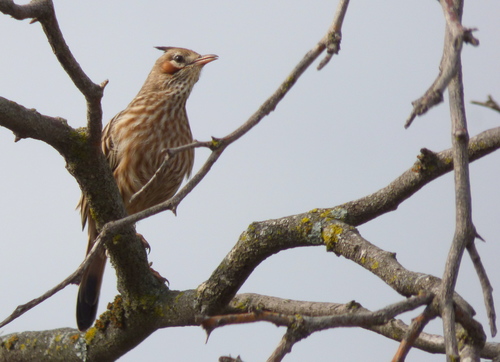
Greater Thornbird (Phacellodomus ruber) Greater Thornbird
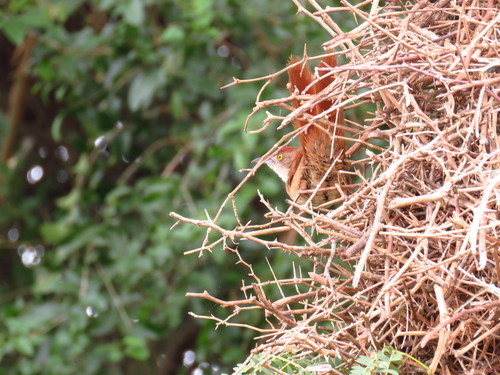
Lark-like Brushrunner (Coryphistera alaudina) Lark-like Brushrunner

Media

Loading…

In short

The Greater Thornbird and Lark-like Brushrunner are both members of the Furnariidae family, but they differ notably in structure and behavior. The Greater Thornbird has a more robust build with a thicker bill, while the Lark-like Brushrunner is more slender and resembles a lark in posture and movement.

Identification tips

  1. Look for the thicker bill and rufous coloration of the Greater Thornbird. 2. Observe the slender build and streaked underparts of the Lark-like Brushrunner. 3. Note the habitat: Greater Thornbirds in wooded areas, Lark-like Brushrunners in open fields. 4. Listen for the Greater Thornbird's harsh calls versus the Brushrunner's softer sounds.

Size

The Greater Thornbird is generally bulkier, while the Lark-like Brushrunner is more slender and lark-like in appearance.

Plumage

Both species have earthy tones, but the Greater Thornbird tends to have a more rufous coloration, especially on the wings and tail. The Lark-like Brushrunner has a paler, more streaked appearance, particularly on the underparts.

Behaviour

The Greater Thornbird is known for its elaborate stick nests and tends to be more arboreal, often seen in pairs or small groups. In contrast, the Lark-like Brushrunner is more terrestrial, often seen running on the ground in open areas.

Habitat

Greater Thornbirds are typically found in more wooded areas, such as forest edges and scrublands. Lark-like Brushrunners prefer open habitats like savannas and grasslands.

Voice

The Greater Thornbird has a loud, harsh call, while the Lark-like Brushrunner's vocalizations are softer and more melodic. However, vocalizations can be variable and are not always the most reliable distinguishing feature.

Submit a better description

Use the same sections as the comparison. Your text is published immediately.

The Greater Thornbird and Lark-like Brushrunner are both members of the Furnariidae family, but they differ notably in structure and behavior. The Greater Thornbird has a more robust build with a thicker bill, while the Lark-like Brushrunner is more slender and resembles a lark in posture and movement.

  1. Look for the thicker bill and rufous coloration of the Greater Thornbird. 2. Observe the slender build and streaked underparts of the Lark-like Brushrunner. 3. Note the habitat: Greater Thornbirds in wooded areas, Lark-like Brushrunners in open fields. 4. Listen for the Greater Thornbird's harsh calls versus the Brushrunner's softer sounds.

The Greater Thornbird is generally bulkier, while the Lark-like Brushrunner is more slender and lark-like in appearance.

Both species have earthy tones, but the Greater Thornbird tends to have a more rufous coloration, especially on the wings and tail. The Lark-like Brushrunner has a paler, more streaked appearance, particularly on the underparts.

The Greater Thornbird is known for its elaborate stick nests and tends to be more arboreal, often seen in pairs or small groups. In contrast, the Lark-like Brushrunner is more terrestrial, often seen running on the ground in open areas.

Greater Thornbirds are typically found in more wooded areas, such as forest edges and scrublands. Lark-like Brushrunners prefer open habitats like savannas and grasslands.

The Greater Thornbird has a loud, harsh call, while the Lark-like Brushrunner's vocalizations are softer and more melodic. However, vocalizations can be variable and are not always the most reliable distinguishing feature.

Discard your changes?

You have unsaved edits. If you leave now, those changes will be lost.

Greater Thornbird · Lark-like Brushrunner · My Tricky Birds