
Greater White-fronted Goose vs Cackling Goose
Anser albifrons versus Branta hutchinsii
Play a quiz with Greater White-fronted Goose and Cackling Goose
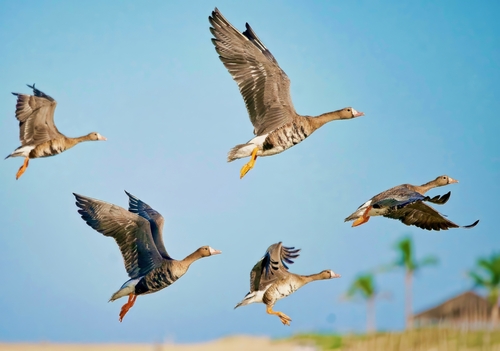 Greater White-fronted Goose
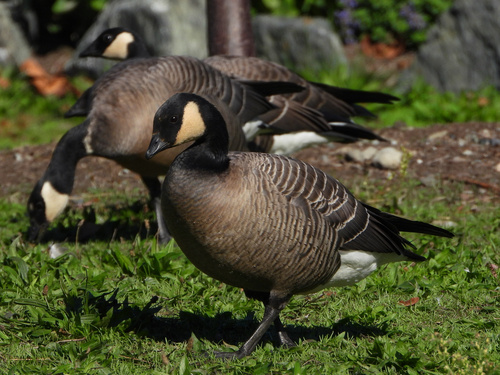 Cackling Goose
In short
The most reliable field mark to separate Greater White-fronted Goose from Cackling Goose is the combination of bill color and face pattern: Greater White-fronted has a pinkish bill and a white blaze at the base of the bill, while Cackling Goose has a black bill and a white chinstrap across the black neck. In flight or at rest, Greater White-fronted shows orange legs and a more uniformly brownish body with belly barring, while Cackling Goose has black legs and a brownish body with a striking black neck and head. Juvenile and adult wing patterns are not strongly diagnostic between these two, but overall structure and face pattern are key. Size can overlap, but Greater White-fronted is generally larger and bulkier than all but the largest Cackling subspecies.
Identification tips
- Face pattern is key: Greater White-fronted Goose has a white blaze at the base of the bill (not reaching the eye), while Cackling Goose has a white chinstrap across a black neck and head. This is the most reliable mark at all ages and distances.
- Bill color and shape: Greater White-fronted has a pinkish (sometimes orange-yellow) bill that is relatively short and thick; Cackling Goose has a black bill that is shorter and stubbier, especially in the smallest subspecies. Bill color is visible even at a distance in good light.
- Leg color: Greater White-fronted shows bright orange legs; Cackling Goose has black legs. This is especially useful when birds are walking or standing.
- Belly barring: Adult Greater White-fronted often show black blotches or bars on the belly, but this can be variable and is absent in juveniles. Cackling Goose never shows belly barring.
- Upperwing pattern in flight: Greater White-fronted (especially nominate subspecies) shows pale fringes to upperwing coverts and a bold white wing bar; Cackling Goose has more uniform dark upperwings without strong pale fringes or wing bars. This is subtle and best seen in close, good light.
- Body color and flank line: Greater White-fronted has a broad, bright white flank line and a generally warmer brown body; Cackling Goose is more uniformly brown with no flank line.
- Tail pattern: Greater White-fronted has a dark tail with a broad white tip and sides; Cackling Goose has a more uniform tail without a strong white tip.
- Neck and head color: Cackling Goose has a solid black neck and head, contrasting sharply with the brown body; Greater White-fronted has a brown neck and head with only the white blaze at the bill base.
- Size and structure: Greater White-fronted is generally larger and longer-necked, but beware overlap with large Cackling subspecies. Use size only in direct comparison or with experience.
- Jizz in flight: Greater White-fronted appears longer-winged, heavier, and more ponderous; Cackling Goose is compact, short-necked, and often flaps more rapidly.
- Voice: Greater White-fronted gives a high-pitched, laughing 'he-he' call; Cackling Goose gives higher-pitched yelps or squeaks, but these can be confused at a distance.
- Juvenile confusion: Young Greater White-fronted lack belly barring but still show the white blaze and pinkish bill; juvenile Cackling always has the chinstrap and black bill.
- Mixing with other geese: Cackling Goose often occurs with Canada Geese; Greater White-fronted may be with other gray geese. Always check for face and bill pattern in mixed flocks.
- Season and sex: Both sexes are similar in both species; seasonal variation is minimal for these marks. Focus on structural and facial features year-round.
- Pitfalls: Do not rely on belly barring alone (variable in Greater White-fronted, absent in juveniles); do not confuse the white blaze of Greater White-fronted with the chinstrap of Cackling—location and extent are different.
Size
Greater White-fronted Goose is typically larger, measuring 64–81 cm in length, with a wingspan of 130–165 cm and a weight of 1.93–3.31 kg [wikipedia][avonet]. Cackling Goose is smaller overall, with most subspecies in the 63–65 cm length range, a wingspan of 108–111 cm, and weight from 1.4–2.38 kg (though the largest subspecies can approach the lower end of Greater White-fronted's size range) [wikipedia][avonet]. However, beware that some Cackling Goose subspecies (especially B. h. hutchinsii) can overlap in size with small Greater White-fronted, so size alone is not always definitive.
Plumage
For all ages, Greater White-fronted Goose shows a distinctive white blaze at the base of the bill (not extending up to the eye), orange legs, and a pinkish bill. Adults have variable black barring on the belly and a generally uniform brownish body with pale fringes on the upperparts and a broad white flank line. In flight, the upperwing coverts are mouse-colored with pale fringes, and the greater coverts have prominent white tips forming a bold wing bar (especially in the nominate subspecies). Juveniles and immatures lack strong belly barring but retain the face pattern and bill color. Cackling Goose, by contrast, has a black head and neck with a white chinstrap that runs from ear to ear under the bill, black bill and legs, and a brownish body with no white blaze at the bill base and no belly barring. The body is more uniform brown, and the upperwing lacks the bold wing bars seen in Greater White-fronted. Juveniles resemble adults but may have slightly duller plumage; the chinstrap is always present. No age-specific upperwing pattern is strongly diagnostic between these two, so focus on face and bill.
Behaviour
Both species are gregarious and often found in flocks, but Greater White-fronted Goose may appear slightly bulkier and more ponderous in movement, with a more horizontal posture when feeding. Cackling Goose is more compact, with a shorter neck and a more upright stance, especially when alert. In flight, Greater White-fronted appears longer-winged and heavier-bodied, while Cackling Goose is more compact and may flap more rapidly. Both species graze in open fields and wetlands, but Cackling Goose often mixes with Canada Geese, which can complicate identification.
Habitat
Both species occur in open wetlands, lakes, and agricultural fields, especially during migration and winter. Greater White-fronted Goose is more likely to be found in mixed flocks with other gray geese, while Cackling Goose is often seen with Canada Geese. In North America, Cackling Goose is more common in the west and north, but both can overlap widely in migration and wintering areas. Habitat alone is not diagnostic.
Voice
Greater White-fronted Goose gives a high-pitched, laughing or cackling call described as 'he-he', with a distinctive break between notes. Cackling Goose has a higher-pitched, yelping or squeaky call compared to Canada Goose, but this is less distinctive when compared to Greater White-fronted. Voice can help, but is best used in combination with visual marks.
Greater White-fronted Goose · Cackling Goose · My Tricky Birds