
Greater White-fronted Goose vs Lesser White-fronted Goose
Anser albifrons versus Anser erythropus
Play a quiz with Greater White-fronted Goose and Lesser White-fronted Goose
 Greater White-fronted Goose
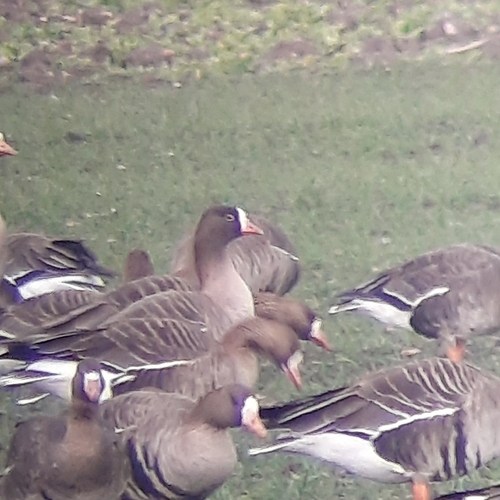 Lesser White-fronted Goose
In short
The most reliable field mark to separate Greater and Lesser White-fronted Geese is the presence of a distinct yellow eye-ring and a more extensive white facial blaze reaching the crown on the Lesser, which the Greater lacks. Size is also a strong clue: Lesser is notably smaller, barely larger than a Mallard, while Greater is a bulkier, longer-necked goose. Both species have orange legs and a white blaze at the bill base, but the Lesser’s smaller, more compact structure and unique eye-ring are diagnostic at any age. In flight or at rest, look for the Lesser’s shorter bill and rounder head, versus the Greater’s longer, pinkish bill and more sloping face. Immature and adult birds can be confused, but the eye-ring and facial blaze are reliable in all plumages.
Identification tips
- Yellow eye-ring (Lesser only): The most diagnostic mark—present in all ages and plumages of Lesser White-fronted Goose, absent in Greater. Look for it in good light.
- Facial blaze shape: Lesser’s white blaze extends up to the crown, forming a broad, high forehead; Greater’s blaze is smaller and does not reach the crown.
- Size and structure: Lesser is much smaller, with a compact body, short neck, and rounder head—barely larger than a Mallard. Greater is noticeably bulkier, longer-necked, and longer-bodied.
- Bill shape and color: Lesser’s bill is short, stubby, and proportionally small for a goose; Greater’s bill is longer, pinkish, and more prominent. Bill color is variable but structure is consistent.
- Belly barring: Both species show black bars on the belly, but the extent is highly variable and not reliable for separation.
- Leg color: Both have orange legs—do not use this for separation.
- Upperwing coverts: Both have mouse-grey upperwing coverts, unlike Greylag Goose, but this does not separate Lesser from Greater.
- Jizz in flight: Lesser appears compact, with a short neck and rounded head; Greater looks longer and heavier in flight and on the ground.
- Juvenile/immature birds: The yellow eye-ring and facial blaze shape remain reliable; no distinctive upperwing or flight marks are described for separation at these ages.
- Vocalization: Greater’s high-pitched cackle is described, but Lesser’s voice is not detailed—use with caution.
- Habitat and context: Lesser is much rarer in most of Europe and Asia; a small, compact white-fronted goose in a flock of Greaters should always be checked for eye-ring and blaze.
- Sex and age: Both sexes are similar in each species; size and facial features are reliable across all ages and sexes.
- Pitfalls: Do not rely on belly barring or leg color. Bill color can overlap, but bill size and shape are consistent.
- Lighting: The yellow eye-ring is most obvious in dull, even light; in bright sun it may be harder to see.
- Comparison with Greylag: Both white-fronted geese have orange legs and mouse-grey upperwings, unlike Greylag’s flesh-colored legs and bluish-grey upperwings—do not confuse these marks with those needed to separate Greater from Lesser.
Size
Greater White-fronted Goose is substantially larger: 64–81 cm in length with a 130–165 cm wingspan, and weighs up to 3.3 kg. Lesser White-fronted Goose is much smaller, at 53–66 cm length, 120–135 cm wingspan, and about 1.8 kg. In the field, Lesser often appears only slightly larger than a Mallard, while Greater is a classic, robust goose. The difference is most obvious when both species are together, but even singly, Lesser’s compactness and short neck stand out.
Plumage
Both species share orange legs, mouse-grey upperwing coverts, and a white blaze at the bill base, but key differences exist. Adult Lesser White-fronted Geese have a conspicuous yellow eye-ring and a white facial blaze that extends up to the crown, unlike Greater, where the blaze stops lower on the face and there is no eye-ring. Both show black belly bars, but the extent is variable and not reliable for separation. Bill color differs: Greater usually has a pinkish bill (sometimes with a hint of dark at the nail), while Lesser’s bill is shorter and stubbier, often pinkish but proportionally smaller. Juvenile and immature plumages are not described in detail for flight marks, but the facial pattern and eye-ring remain the best clues at all ages. Subtle differences in upperwing covert barring exist within Greater’s subspecies, but these are not relevant for separating from Lesser.
Behaviour
Behavior is not a strong separator between these two species. Both are gregarious, often seen in flocks, and feed in open fields or wetlands. Lesser may appear more alert and upright due to its shorter neck and compact build, but this is subtle and best used in combination with structural and plumage marks.
Habitat
Habitat overlap is extensive, especially in migration and winter. Both species breed in northern tundra regions and winter in open wetlands, lakes, and agricultural fields. Lesser is much rarer in Europe and Asia, with only small, scattered breeding populations and reintroduction attempts. In most of Europe, encountering a Lesser is unusual compared to the widespread Greater.
Voice
Greater White-fronted Goose is known for its high-pitched cackling calls, often described as 'he-he', with a distinct break between notes. There is no detailed description of Lesser’s voice in the notes, so vocalization is not a reliable separator unless the call is distinctive and known.
Greater White-fronted Goose · Lesser White-fronted Goose · My Tricky Birds