Birdr

Green Pygmy-Goose vs Cotton Pygmy-Goose

Nettapus pulchellus versus Nettapus coromandelianus

Play a quiz with Green Pygmy-Goose and Cotton Pygmy-Goose
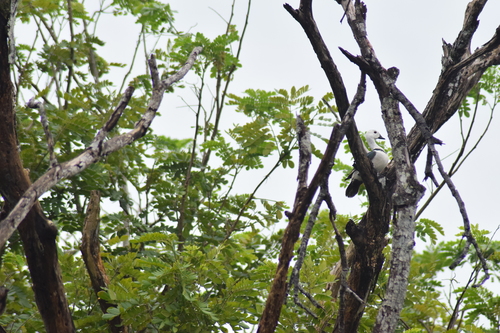
Green Pygmy-Goose (Nettapus pulchellus) Green Pygmy-Goose
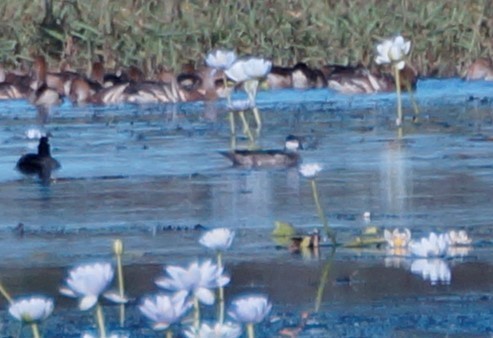
Cotton Pygmy-Goose (Nettapus coromandelianus) Cotton Pygmy-Goose

Media

Loading…

In short

The Green Pygmy-Goose and Cotton Pygmy-Goose are small waterfowl often found in similar wetland habitats, but they can be distinguished by their plumage and behavior. The Green Pygmy-Goose typically shows a more vibrant green coloration on the head and neck, while the Cotton Pygmy-Goose has a more subdued, cottony white appearance with a distinctive black cap. Observing their behavior and habitat preferences can also aid in identification.

Identification tips

Size

Both species are similar in size, being small ducks, but the Cotton Pygmy-Goose may appear slightly more compact.

Plumage

The Green Pygmy-Goose has a striking green head and neck with a white face and chest, while the Cotton Pygmy-Goose features a black cap and white face, with a more overall white and grey appearance.

Behaviour

Both species are social and can be seen in flocks, but the Cotton Pygmy-Goose is more likely to form larger groups outside the breeding season.

Habitat

Both prefer wetlands with abundant floating vegetation, but the Cotton Pygmy-Goose has a broader range, extending from Nepal to northeastern Australia, and is more migratory.

Voice

Vocalizations are not well-documented for either species, but any differences are subtle and not reliable for field identification.

Submit a better description

Use the same sections as the comparison. Your text is published immediately.

The Green Pygmy-Goose and Cotton Pygmy-Goose are small waterfowl often found in similar wetland habitats, but they can be distinguished by their plumage and behavior. The Green Pygmy-Goose typically shows a more vibrant green coloration on the head and neck, while the Cotton Pygmy-Goose has a more subdued, cottony white appearance with a distinctive black cap. Observing their behavior and habitat preferences can also aid in identification.

  • Look for the green head and neck of the Green Pygmy-Goose versus the black cap and white face of the Cotton Pygmy-Goose.
  • Observe flock size and behavior; larger flocks may indicate Cotton Pygmy-Goose.
  • Consider geographic location; if in northern parts of the range, Cotton Pygmy-Goose is more likely.

Both species are similar in size, being small ducks, but the Cotton Pygmy-Goose may appear slightly more compact.

The Green Pygmy-Goose has a striking green head and neck with a white face and chest, while the Cotton Pygmy-Goose features a black cap and white face, with a more overall white and grey appearance.

Both species are social and can be seen in flocks, but the Cotton Pygmy-Goose is more likely to form larger groups outside the breeding season.

Both prefer wetlands with abundant floating vegetation, but the Cotton Pygmy-Goose has a broader range, extending from Nepal to northeastern Australia, and is more migratory.

Vocalizations are not well-documented for either species, but any differences are subtle and not reliable for field identification.

Discard your changes?

You have unsaved edits. If you leave now, those changes will be lost.

Green Pygmy-Goose · Cotton Pygmy-Goose · My Tricky Birds