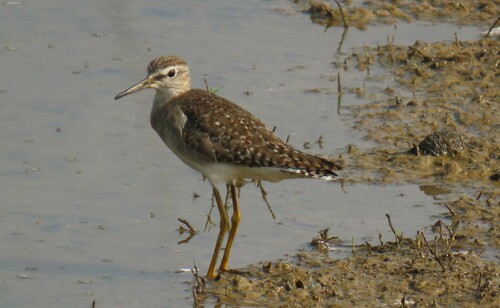
Green Sandpiper vs Wood Sandpiper
Tringa ochropus versus Tringa glareola
Play a quiz with Green Sandpiper and Wood Sandpiper
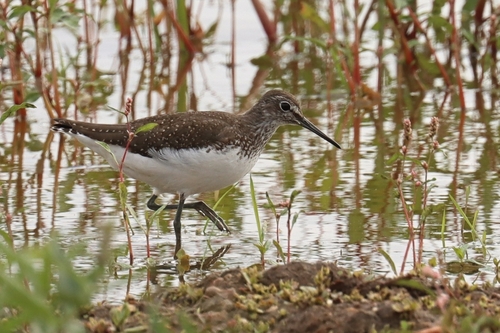
Green Sandpiper
Wood Sandpiper
In short
The Green Sandpiper is best distinguished from the Wood Sandpiper by its darker, more contrasting plumage and lack of a prominent supercilium. In contrast, the Wood Sandpiper has a more pronounced white supercilium and lighter, more speckled upperparts. Both species are similar in size and structure, but their plumage and behavior can help in identification.
Identification tips
- Look for the darker plumage and lack of a prominent supercilium in the Green Sandpiper.
- Note the pronounced white supercilium and speckled upperparts of the Wood Sandpiper.
- Observe habitat preferences: Green Sandpipers in wooded wetlands, Wood Sandpipers in open marshes.
- Listen for the Green Sandpiper's high-pitched 'weet-weet' call versus the Wood Sandpiper's trilled calls.
Size
Both species are similar in size, with the Green Sandpiper being slightly bulkier.
Plumage
The Green Sandpiper has darker, more uniform upperparts with less speckling and lacks the prominent white supercilium found in the Wood Sandpiper. The Wood Sandpiper displays more speckled upperparts and a distinct white supercilium that extends behind the eye.
Behaviour
Green Sandpipers are often seen alone or in small groups, while Wood Sandpipers are more likely to be found in larger flocks. Both species exhibit similar foraging behaviors, but the Green Sandpiper tends to be more solitary.
Habitat
Green Sandpipers prefer wooded wetlands and are often found in more shaded, forested areas. Wood Sandpipers are more likely to be found in open wetlands, such as marshes and flooded fields.
Voice
The Green Sandpiper's call is a distinctive, high-pitched 'weet-weet' that differs from the Wood Sandpiper's more musical and trilled calls.