Birdr

Green-throated Carib vs Grey Kingbird

Eulampis holosericeus versus Tyrannus dominicensis

Play a quiz with Green-throated Carib and Grey Kingbird
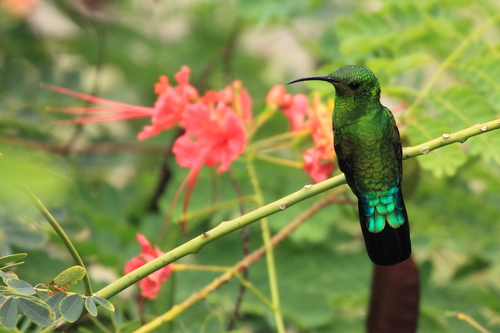
Green-throated Carib (Eulampis holosericeus) Green-throated Carib
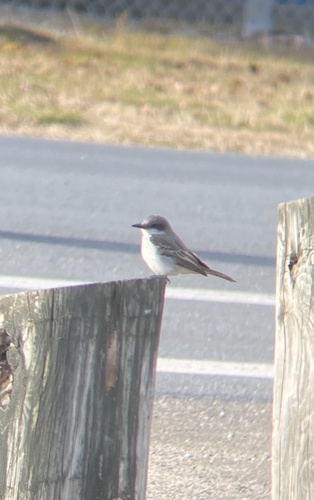
Grey Kingbird (Tyrannus dominicensis) Grey Kingbird

Media

Loading…

In short

The Green-throated Carib and the Gray Kingbird are distinct in both appearance and habitat. The Carib is a large, iridescent hummingbird with a brilliant green throat, while the Kingbird is a gray, robust flycatcher often seen perched conspicuously in open areas. Their habitats rarely overlap, with the Carib favoring forested areas and the Kingbird preferring coastal regions.

Identification tips

  1. Location: If you're in a forested area, it's more likely a Green-throated Carib; if near the coast, consider the Gray Kingbird. 2. Size and Shape: Look for the Carib's smaller, more streamlined hummingbird shape versus the Kingbird's larger, more robust flycatcher form. 3. Plumage: Note the Carib's iridescent green throat and blue accents compared to the Kingbird's gray and white plumage with a dark eye mask. 4. Behavior: Observe feeding behavior; hovering at flowers suggests a Carib, while perching and sallying for insects suggests a Kingbird.

Size

The Green-throated Carib is a large hummingbird, but still smaller than the robust Gray Kingbird.

Plumage

The Green-throated Carib features a brilliant green gorget and metallic blue bordering, with a black belly. In contrast, the Gray Kingbird is predominantly gray with a darker mask through the eye and a white underbelly.

Behaviour

Green-throated Caribs are often seen hovering around flowers, while Gray Kingbirds are more likely to be seen perched on exposed branches or wires, sallying out to catch insects.

Habitat

Green-throated Caribs inhabit wet forests and semi-deciduous woodlands, while Gray Kingbirds are found in open, coastal areas often associated with water.

Voice

The Green-throated Carib's vocalizations are typical of hummingbirds, often high-pitched and rapid, whereas the Gray Kingbird is known for its loud, harsh calls.

Submit a better description

Use the same sections as the comparison. Your text is published immediately.

The Green-throated Carib and the Gray Kingbird are distinct in both appearance and habitat. The Carib is a large, iridescent hummingbird with a brilliant green throat, while the Kingbird is a gray, robust flycatcher often seen perched conspicuously in open areas. Their habitats rarely overlap, with the Carib favoring forested areas and the Kingbird preferring coastal regions.

  1. Location: If you're in a forested area, it's more likely a Green-throated Carib; if near the coast, consider the Gray Kingbird. 2. Size and Shape: Look for the Carib's smaller, more streamlined hummingbird shape versus the Kingbird's larger, more robust flycatcher form. 3. Plumage: Note the Carib's iridescent green throat and blue accents compared to the Kingbird's gray and white plumage with a dark eye mask. 4. Behavior: Observe feeding behavior; hovering at flowers suggests a Carib, while perching and sallying for insects suggests a Kingbird.

The Green-throated Carib is a large hummingbird, but still smaller than the robust Gray Kingbird.

The Green-throated Carib features a brilliant green gorget and metallic blue bordering, with a black belly. In contrast, the Gray Kingbird is predominantly gray with a darker mask through the eye and a white underbelly.

Green-throated Caribs are often seen hovering around flowers, while Gray Kingbirds are more likely to be seen perched on exposed branches or wires, sallying out to catch insects.

Green-throated Caribs inhabit wet forests and semi-deciduous woodlands, while Gray Kingbirds are found in open, coastal areas often associated with water.

The Green-throated Carib's vocalizations are typical of hummingbirds, often high-pitched and rapid, whereas the Gray Kingbird is known for its loud, harsh calls.

Discard your changes?

You have unsaved edits. If you leave now, those changes will be lost.

Green-throated Carib · Grey Kingbird · My Tricky Birds