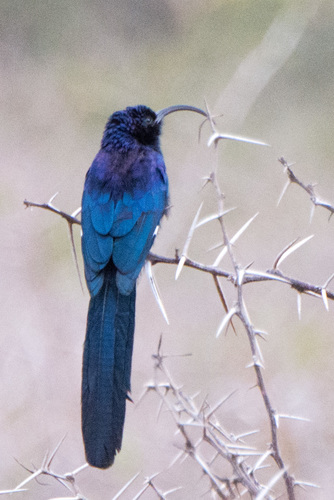
Green Woodhoopoe vs Common Scimitarbill
Phoeniculus purpureus versus Rhinopomastus cyanomelas
Play a quiz with Green Woodhoopoe and Common Scimitarbill
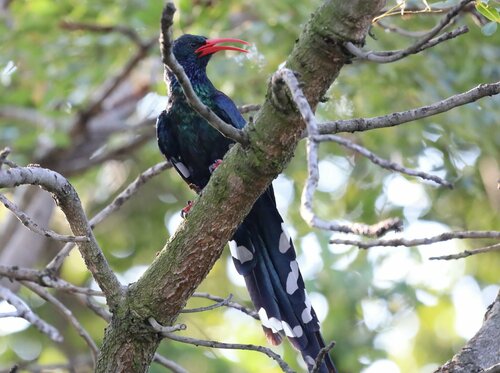
Green Woodhoopoe
Common Scimitarbill
In short
To distinguish the Green Woodhoopoe from the Common Scimitarbill, focus on the bill shape and tail length. The Green Woodhoopoe has a longer, decurved bill and a notably longer tail with white tips, while the Common Scimitarbill has a shorter, more strongly curved bill and a shorter tail. Both species are similar in size and share iridescent plumage, but these structural differences are key.
Identification tips
1. Bill shape: Green Woodhoopoe has a longer, less curved bill; Common Scimitarbill's bill is shorter and more strongly curved. 2. Tail length and markings: Green Woodhoopoe has a longer tail with white tips; Common Scimitarbill has a shorter tail without white tips. 3. Vocalizations: Listen for the Green Woodhoopoe's loud, cackling calls, often in groups. 4. Group size: Green Woodhoopoe often in larger, noisier flocks; Common Scimitarbill more solitary or in pairs.
Size
Both species are similar in size, but the Green Woodhoopoe appears larger due to its longer tail.
Plumage
Both species have iridescent plumage, but the Green Woodhoopoe's tail has distinctive white tips, which the Common Scimitarbill lacks.
Behaviour
Both species are active and often seen in small groups, but the Green Woodhoopoe is more likely to be observed in larger, noisier flocks.
Habitat
Both species inhabit wooded areas, but the Green Woodhoopoe is more commonly found in open woodlands and savannas, while the Common Scimitarbill prefers drier, more open habitats.
Voice
The Green Woodhoopoe is known for its loud, cackling calls, often given in chorus, while the Common Scimitarbill's calls are quieter and less social.