Birdr

Grey-backed Sparrow-Lark vs Yellow-throated Bush Sparrow

Eremopterix verticalis versus Gymnoris superciliaris

Play a quiz with Grey-backed Sparrow-Lark and Yellow-throated Bush Sparrow
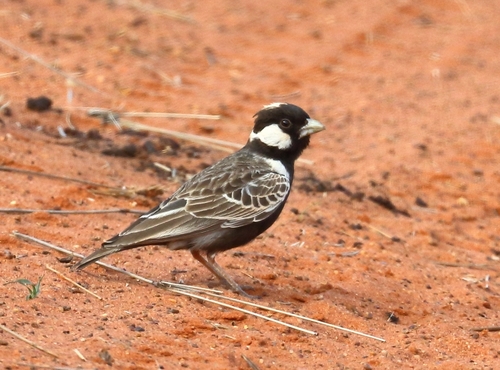
Grey-backed Sparrow-Lark (Eremopterix verticalis) Grey-backed Sparrow-Lark
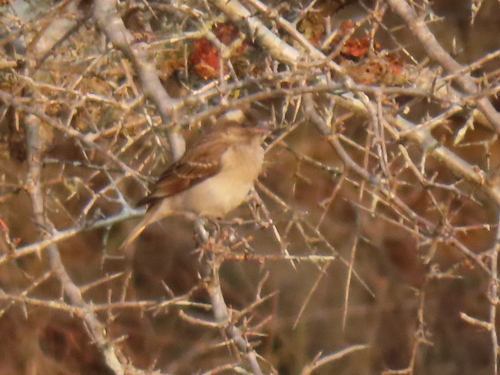
Yellow-throated Bush Sparrow (Gymnoris superciliaris) Yellow-throated Bush Sparrow

Media

Loading…

In short

The Grey-backed Sparrow-Lark and Yellow-throated Bush Sparrow can be distinguished primarily by their plumage and habitat preferences. The Sparrow-Lark has a more uniform grey-brown appearance, while the Bush Sparrow features a distinctive yellow throat. Both species occupy different habitats, which can aid in identification.

Identification tips

  1. Look for the yellow throat and supercilium on the Yellow-throated Bush Sparrow. 2. Note the habitat: open areas suggest Sparrow-Lark, while wooded areas suggest Bush Sparrow. 3. Observe behavior: ground-foraging indicates Sparrow-Lark, while bush or tree activity suggests Bush Sparrow.

Size

Both species are small, but the Grey-backed Sparrow-Lark is generally more compact with a shorter tail compared to the slightly larger and more elongated Yellow-throated Bush Sparrow.

Plumage

The Grey-backed Sparrow-Lark has a grey-brown back and lacks the bright facial markings of the Yellow-throated Bush Sparrow, which is notable for its yellow throat and supercilium. The Sparrow-Lark's plumage is more uniform, whereas the Bush Sparrow has a more contrasting appearance.

Behaviour

The Grey-backed Sparrow-Lark often forages on the ground in open areas, while the Yellow-throated Bush Sparrow is more arboreal, frequently seen in bushes and trees.

Habitat

The Grey-backed Sparrow-Lark prefers open, arid environments such as semi-deserts and grasslands. In contrast, the Yellow-throated Bush Sparrow is typically found in more wooded areas, including savannas and bushlands.

Voice

Vocalizations are not a primary distinguishing feature between these two species in the field, but the Sparrow-Lark's calls are generally simpler compared to the more complex songs of the Bush Sparrow.

Submit a better description

Use the same sections as the comparison. Your text is published immediately.

The Grey-backed Sparrow-Lark and Yellow-throated Bush Sparrow can be distinguished primarily by their plumage and habitat preferences. The Sparrow-Lark has a more uniform grey-brown appearance, while the Bush Sparrow features a distinctive yellow throat. Both species occupy different habitats, which can aid in identification.

  1. Look for the yellow throat and supercilium on the Yellow-throated Bush Sparrow. 2. Note the habitat: open areas suggest Sparrow-Lark, while wooded areas suggest Bush Sparrow. 3. Observe behavior: ground-foraging indicates Sparrow-Lark, while bush or tree activity suggests Bush Sparrow.

Both species are small, but the Grey-backed Sparrow-Lark is generally more compact with a shorter tail compared to the slightly larger and more elongated Yellow-throated Bush Sparrow.

The Grey-backed Sparrow-Lark has a grey-brown back and lacks the bright facial markings of the Yellow-throated Bush Sparrow, which is notable for its yellow throat and supercilium. The Sparrow-Lark's plumage is more uniform, whereas the Bush Sparrow has a more contrasting appearance.

The Grey-backed Sparrow-Lark often forages on the ground in open areas, while the Yellow-throated Bush Sparrow is more arboreal, frequently seen in bushes and trees.

The Grey-backed Sparrow-Lark prefers open, arid environments such as semi-deserts and grasslands. In contrast, the Yellow-throated Bush Sparrow is typically found in more wooded areas, including savannas and bushlands.

Vocalizations are not a primary distinguishing feature between these two species in the field, but the Sparrow-Lark's calls are generally simpler compared to the more complex songs of the Bush Sparrow.

Discard your changes?

You have unsaved edits. If you leave now, those changes will be lost.

Grey-backed Sparrow-Lark · Yellow-throated Bush Sparrow · My Tricky Birds