Birdr

Grey-backed Thrush vs Eyebrowed Thrush

Turdus hortulorum versus Turdus obscurus

Play a quiz with Grey-backed Thrush and Eyebrowed Thrush
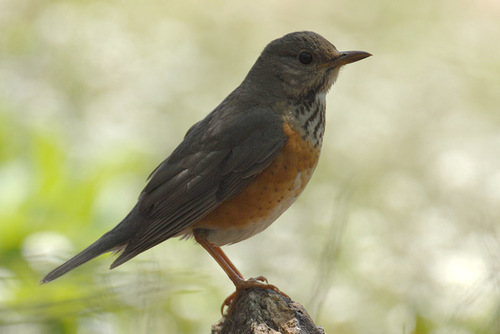
Grey-backed Thrush (Turdus hortulorum) Grey-backed Thrush
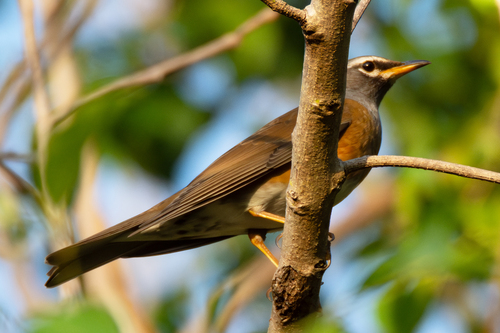
Eyebrowed Thrush (Turdus obscurus) Eyebrowed Thrush

Media

Loading…

In short

The Grey-backed Thrush and Eyebrowed Thrush are both medium-sized thrushes, but they can be distinguished by their plumage and facial markings. The Grey-backed Thrush has a distinctive grey back and lacks the prominent supercilium found in the Eyebrowed Thrush. Observing these features, especially the supercilium, is key in differentiating these species.

Identification tips

  1. Look for the supercilium: Eyebrowed Thrush has a prominent white or buff supercilium, while Grey-backed Thrush lacks this feature. 2. Check the back color: Grey-backed Thrush has a grey back, contrasting with the more uniform brown back of the Eyebrowed Thrush. 3. Observe in good light to ensure accurate color and marking identification.

Size

Both species are similar in size, typical of medium-sized thrushes, making size an unreliable distinguishing feature.

Plumage

The Grey-backed Thrush has a grey back and lacks the strong supercilium of the Eyebrowed Thrush. The Eyebrowed Thrush features a prominent white or buff supercilium and a more uniform brown back.

Behaviour

Both species exhibit typical thrush behavior, often foraging on the ground or in low vegetation, making behavior a less useful distinguishing factor.

Habitat

Both species can be found in similar habitats, such as forests and wooded areas, particularly during migration, so habitat alone may not aid in identification.

Voice

Vocalizations are not a reliable distinguishing feature in the field, as both species have similar calls and songs that can vary regionally.

Submit a better description

Use the same sections as the comparison. Your text is published immediately.

The Grey-backed Thrush and Eyebrowed Thrush are both medium-sized thrushes, but they can be distinguished by their plumage and facial markings. The Grey-backed Thrush has a distinctive grey back and lacks the prominent supercilium found in the Eyebrowed Thrush. Observing these features, especially the supercilium, is key in differentiating these species.

  1. Look for the supercilium: Eyebrowed Thrush has a prominent white or buff supercilium, while Grey-backed Thrush lacks this feature. 2. Check the back color: Grey-backed Thrush has a grey back, contrasting with the more uniform brown back of the Eyebrowed Thrush. 3. Observe in good light to ensure accurate color and marking identification.

Both species are similar in size, typical of medium-sized thrushes, making size an unreliable distinguishing feature.

The Grey-backed Thrush has a grey back and lacks the strong supercilium of the Eyebrowed Thrush. The Eyebrowed Thrush features a prominent white or buff supercilium and a more uniform brown back.

Both species exhibit typical thrush behavior, often foraging on the ground or in low vegetation, making behavior a less useful distinguishing factor.

Both species can be found in similar habitats, such as forests and wooded areas, particularly during migration, so habitat alone may not aid in identification.

Vocalizations are not a reliable distinguishing feature in the field, as both species have similar calls and songs that can vary regionally.

Discard your changes?

You have unsaved edits. If you leave now, those changes will be lost.

Grey-backed Thrush · Eyebrowed Thrush · My Tricky Birds