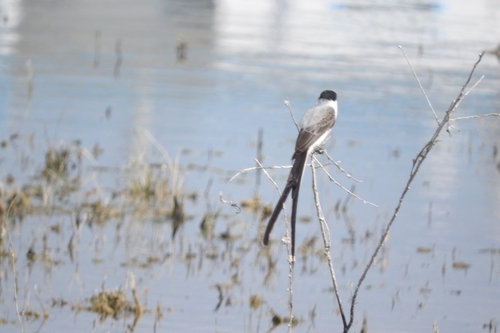
Grey-capped Flycatcher vs Fork-tailed Flycatcher
Myiozetetes granadensis versus Tyrannus savana
Play a quiz with Grey-capped Flycatcher and Fork-tailed Flycatcher
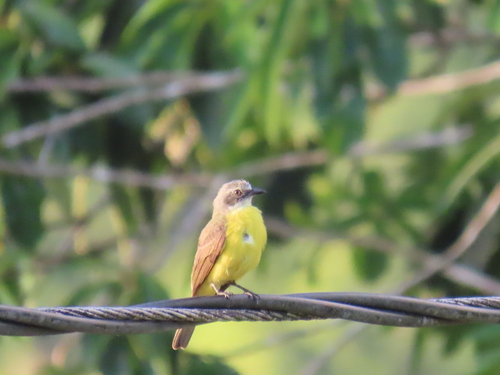
Grey-capped Flycatcher
Fork-tailed Flycatcher
In short
The Fork-tailed Flycatcher is unmistakable with its extremely long, deeply forked tail, whereas the Grey-capped Flycatcher has a more typical flycatcher tail. Both species have yellow underparts, but the Grey-capped Flycatcher features a gray head with a white supercilium, unlike the Fork-tailed Flycatcher's contrasting black cap and white underparts.
Identification tips
- Look for the long, forked tail of the Fork-tailed Flycatcher.
- Note the gray head and white supercilium of the Grey-capped Flycatcher.
- Observe behavior: Fork-tailed Flycatchers often perch in open areas, while Grey-capped Flycatchers are near water.
- Listen for the vocalizations: Grey-capped Flycatchers are more vocal with distinctive calls.
Size
The Fork-tailed Flycatcher is larger, especially noticeable due to its long tail, while the Grey-capped Flycatcher is more compact.
Plumage
The Grey-capped Flycatcher has a gray head with a white supercilium and olive upperparts, while the Fork-tailed Flycatcher has a striking black cap, white underparts, and a long, forked tail.
Behaviour
The Fork-tailed Flycatcher often perches conspicuously on wires or open branches, showcasing its tail. The Grey-capped Flycatcher is more likely to be found near water and is highly vocal.
Habitat
The Grey-capped Flycatcher is typically found in forests near water below 1100 meters. The Fork-tailed Flycatcher is more adaptable, often seen in open areas, pastures, and edges of forests.
Voice
The Grey-capped Flycatcher is highly vocal with sharp calls and kiskadee-like sounds. The Fork-tailed Flycatcher's calls are less distinctive in comparison.
Grey-capped Flycatcher · Fork-tailed Flycatcher · My Tricky Birds