Birdr

Grey Catbird vs Northern Mockingbird

Dumetella carolinensis versus Mimus polyglottos

Play a quiz with Grey Catbird and Northern Mockingbird
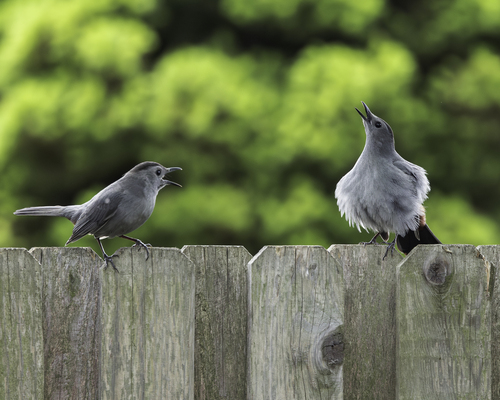
Grey Catbird (Dumetella carolinensis) Grey Catbird
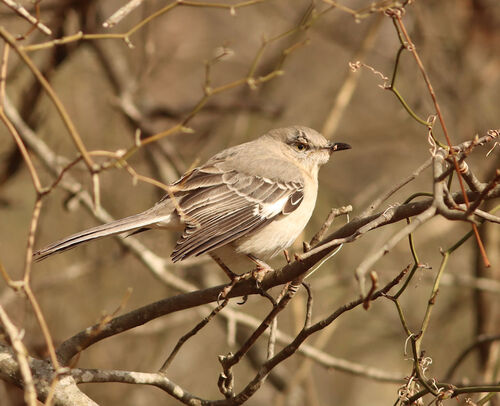
Northern Mockingbird (Mimus polyglottos) Northern Mockingbird

Media

Loading…

In short

The Grey Catbird and Northern Mockingbird are both members of the Mimidae family, but they can be distinguished by their size, plumage, and vocalizations. The Northern Mockingbird is larger and more conspicuous, often seen performing its distinctive wing-flashing behavior, while the Grey Catbird is more secretive and uniform in color.

Identification tips

Size

The Northern Mockingbird is noticeably larger than the Grey Catbird, with a longer tail and more robust build.

Plumage

The Grey Catbird is uniformly slate gray with a black cap and a distinctive rusty under-tail coverts. In contrast, the Northern Mockingbird has a pale gray body with white wing patches and outer tail feathers, which are conspicuous in flight.

Behaviour

Northern Mockingbirds are known for their bold behavior, often seen wing-flashing and aggressively defending their territory. Grey Catbirds are more secretive, typically skulking in dense shrubs.

Habitat

Grey Catbirds prefer dense, shrubby vegetation, often near the ground. Northern Mockingbirds are more adaptable, found in open areas like parks, suburbs, and cultivated lands.

Voice

Northern Mockingbirds have a varied and complex song, often mimicking other birds and sounds. Grey Catbirds have a simpler song, often described as a cat-like mewing.

Submit a better description

Use the same sections as the comparison. Your text is published immediately.

The Grey Catbird and Northern Mockingbird are both members of the Mimidae family, but they can be distinguished by their size, plumage, and vocalizations. The Northern Mockingbird is larger and more conspicuous, often seen performing its distinctive wing-flashing behavior, while the Grey Catbird is more secretive and uniform in color.

  • Size and Shape: Look for the larger size and longer tail of the Northern Mockingbird.
  • Plumage: Note the uniform gray of the Grey Catbird versus the Northern Mockingbird's white wing patches.
  • Behavior: Observe the Northern Mockingbird's wing-flashing and territorial aggression.
  • Vocalization: Listen for the Northern Mockingbird's varied song compared to the Grey Catbird's simpler calls.

The Northern Mockingbird is noticeably larger than the Grey Catbird, with a longer tail and more robust build.

The Grey Catbird is uniformly slate gray with a black cap and a distinctive rusty under-tail coverts. In contrast, the Northern Mockingbird has a pale gray body with white wing patches and outer tail feathers, which are conspicuous in flight.

Northern Mockingbirds are known for their bold behavior, often seen wing-flashing and aggressively defending their territory. Grey Catbirds are more secretive, typically skulking in dense shrubs.

Grey Catbirds prefer dense, shrubby vegetation, often near the ground. Northern Mockingbirds are more adaptable, found in open areas like parks, suburbs, and cultivated lands.

Northern Mockingbirds have a varied and complex song, often mimicking other birds and sounds. Grey Catbirds have a simpler song, often described as a cat-like mewing.

Discard your changes?

You have unsaved edits. If you leave now, those changes will be lost.

Grey Catbird · Northern Mockingbird · My Tricky Birds