Birdr

Grey Partridge vs Red-legged Partridge

Perdix perdix versus Alectoris rufa

Play a quiz with Grey Partridge and Red-legged Partridge
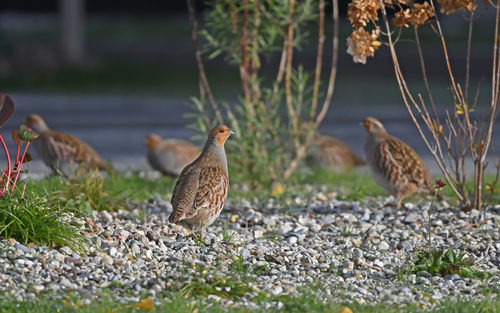
Grey Partridge (Perdix perdix) Grey Partridge
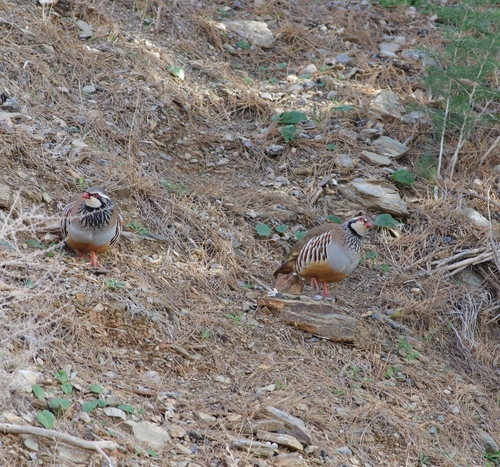
Red-legged Partridge (Alectoris rufa) Red-legged Partridge

Media

Loading…

In short

The Grey Partridge and Red-legged Partridge can be distinguished primarily by their facial markings and leg color. The Grey Partridge has a more muted appearance with a distinctive orange face, while the Red-legged Partridge features bold black and white facial patterns and red legs.

Identification tips

  1. Look for the orange face of the Grey Partridge versus the bold facial markings of the Red-legged Partridge. 2. Check the leg color: Grey Partridges have greyish legs, while Red-legged Partridges have red legs. 3. Observe the habitat: Grey Partridges are more likely in open fields, while Red-legged Partridges may be in varied terrain. 4. Listen for vocalizations: Grey Partridge calls are simpler compared to the more complex calls of the Red-legged Partridge.

Size

Both species are similar in size, typical of medium-sized partridges.

Plumage

The Grey Partridge has a grey-brown body with a more uniform appearance and an orange face. The Red-legged Partridge is more striking with a greyish-brown back, white throat bordered by a black necklace, and red legs.

Behaviour

Both species are ground-dwelling and prefer to run rather than fly when disturbed. They often form coveys outside the breeding season.

Habitat

Grey Partridges are typically found in open farmland and grasslands, while Red-legged Partridges prefer more varied terrain, including scrub and open woodland.

Voice

The calls of these species differ, with the Grey Partridge having a more subdued, repetitive call, while the Red-legged Partridge has a louder, more complex call.

Submit a better description

Use the same sections as the comparison. Your text is published immediately.

The Grey Partridge and Red-legged Partridge can be distinguished primarily by their facial markings and leg color. The Grey Partridge has a more muted appearance with a distinctive orange face, while the Red-legged Partridge features bold black and white facial patterns and red legs.

  1. Look for the orange face of the Grey Partridge versus the bold facial markings of the Red-legged Partridge. 2. Check the leg color: Grey Partridges have greyish legs, while Red-legged Partridges have red legs. 3. Observe the habitat: Grey Partridges are more likely in open fields, while Red-legged Partridges may be in varied terrain. 4. Listen for vocalizations: Grey Partridge calls are simpler compared to the more complex calls of the Red-legged Partridge.

Both species are similar in size, typical of medium-sized partridges.

The Grey Partridge has a grey-brown body with a more uniform appearance and an orange face. The Red-legged Partridge is more striking with a greyish-brown back, white throat bordered by a black necklace, and red legs.

Both species are ground-dwelling and prefer to run rather than fly when disturbed. They often form coveys outside the breeding season.

Grey Partridges are typically found in open farmland and grasslands, while Red-legged Partridges prefer more varied terrain, including scrub and open woodland.

The calls of these species differ, with the Grey Partridge having a more subdued, repetitive call, while the Red-legged Partridge has a louder, more complex call.

Discard your changes?

You have unsaved edits. If you leave now, those changes will be lost.

Grey Partridge · Red-legged Partridge · My Tricky Birds