
Grey Phalarope vs Red-necked Phalarope
Phalaropus fulicarius versus Phalaropus lobatus
Play a quiz with Grey Phalarope and Red-necked Phalarope
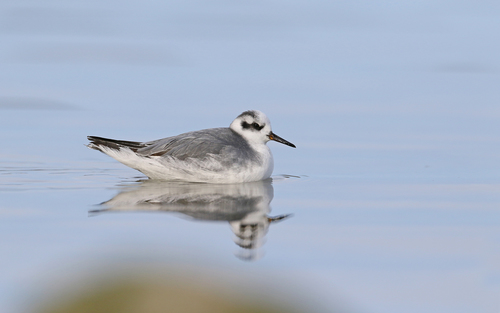 Grey Phalarope
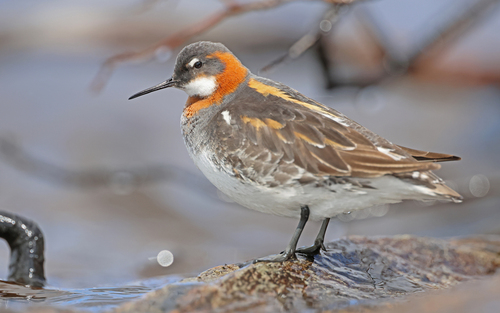 Red-necked Phalarope
In short
The most reliable way to separate Grey (Red) Phalarope from Red-necked Phalarope is by bill structure and overall bulk: Grey Phalarope is noticeably chunkier with a thicker, blunter bill, while Red-necked is more slender with a fine, needle-like bill. In breeding plumage, Grey Phalarope shows rich red underparts and white cheek patches, contrasting with the Red-necked’s chestnut neck and white throat. In winter or juvenile plumages, both species are grey above and white below with a dark eye patch, making structure and bill shape crucial. Juveniles and winter birds are often confused, so focus on bill thickness and overall size, especially at sea or in mixed flocks.
Identification tips
- Bill shape and thickness: Grey Phalarope has a noticeably thicker, blunter bill (yellow with black tip in breeding, black in winter); Red-necked Phalarope’s bill is fine, needle-like, and always black. This is the most reliable mark year-round.
- Overall size and build: Grey Phalarope is larger, rounder, and bulkier; Red-necked is smaller and more delicate. This is apparent in direct comparison or with experience.
- Breeding plumage (female): Grey Phalarope shows rich red underparts and white cheek patches; Red-necked has a chestnut neck and upper breast, black face, and white throat. Both have dark upperparts, but the underpart color and face pattern are distinctive.
- Breeding plumage (male): Both are duller than females but follow the same pattern: Grey Phalarope males are less intensely red, Red-necked males are less bright on the neck.
- Juvenile and winter plumage: Both are grey above, white below, with a dark eye patch. Grey Phalarope juveniles are paler and more buff below; Red-necked juveniles are more contrasting. In winter, both are similar, so rely on structure and bill.
- Face pattern in winter/juvenile: Both have a dark eye patch, but Grey Phalarope’s head appears rounder and the bill stubbier.
- Leg and toe structure: Both have lobed toes, but this is not a useful field mark for separation.
- Feeding behavior: Both spin in circles to feed; behavior is not diagnostic.
- Flight silhouette: Grey Phalarope appears chunkier and broader-winged; Red-necked is slimmer and more agile in flight. No distinctive upperwing pattern is described for either species in juvenile or adult plumage.
- Bill color in breeding: Grey Phalarope’s bill is yellow with a black tip; Red-necked’s is always black.
- Association with flocks: Both species may occur together in mixed flocks at sea; size and bill shape are key in these situations.
- Voice: Calls are slightly different ('beek' for Grey, 'whit/twit' for Red-necked) but not easily separated in the field.
- Context: If seen at sea, both are possible; do not rely on habitat for separation.
- Sexual dimorphism: Both species have reversed sex roles, with females brighter and larger, but this is not a separation mark between species.
- When in doubt: If you cannot judge bill thickness or overall size, and plumage is plain grey and white with a dark eye patch, separation may not be possible without direct comparison or photos.
Size
Grey Phalarope is the larger and bulkier of the two, measuring about 21 cm in length versus the Red-necked Phalarope’s 18 cm. Red-necked Phalarope has a documented average mass of 37 g [wikidata], while Grey Phalarope is heavier (though exact mass is not provided, it is consistently described as larger). In the field, Grey Phalarope appears rounder and more robust, while Red-necked is daintier and more delicate overall.
Plumage
Juvenile and winter birds of both species are similar: grey above, white below, with a dark eye patch. However, breeding plumages are distinct. Breeding Grey Phalarope (female) is dark brown and black above, with rich red underparts and a white cheek patch; the bill is yellow with a black tip. Breeding Red-necked Phalarope (female) is dark grey above, with a striking chestnut neck and upper breast, black face, and white throat; the bill is always fine and black. Juveniles of both have a dark eye stripe, but Grey Phalarope juveniles are paler and more buff below, while Red-necked juveniles are more contrastingly patterned. In winter, both become plainer grey and white, but Grey Phalarope retains a thicker, blunter bill and a rounder head. No distinctive upperwing pattern is described for either species in juvenile or first-winter plumage, so separation relies on structure and subtle plumage cues.
Behaviour
Both species share the unusual phalarope feeding behavior of spinning in tight circles to create a vortex, drawing up prey. Both are often tame and approachable. Grey Phalarope is described as especially tame. Both species may be seen in flocks, especially outside the breeding season, and both are pelagic in migration and winter, often associating with upwellings or marine mammals. There are no strong behavioral differences for field separation beyond the shared spinning feeding style.
Habitat
Both species breed in Arctic regions of North America and Eurasia and winter at sea, often on tropical oceans. On migration and in winter, both are found in pelagic zones, especially where ocean currents converge. There is no strong habitat difference for field separation, though Grey Phalarope may be slightly more oceanic in its migration routes.
Voice
Grey Phalarope gives a short 'beek' call, while Red-necked Phalarope’s call is described as a sharp 'whit' or 'twit.' These calls are brief and high-pitched, and may be difficult to distinguish in the field, especially at sea or in mixed flocks. Vocalizations are not a primary field mark for separation.