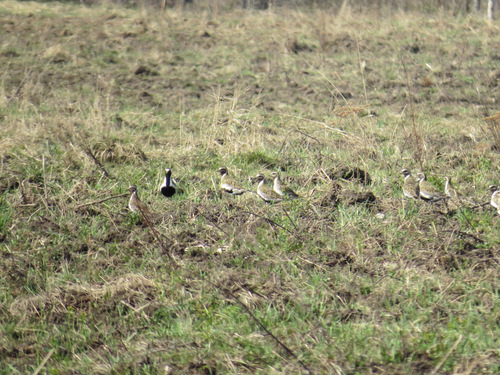
Grey Plover vs European Golden Plover
Pluvialis squatarola versus Pluvialis apricaria
Play a quiz with Grey Plover and European Golden Plover
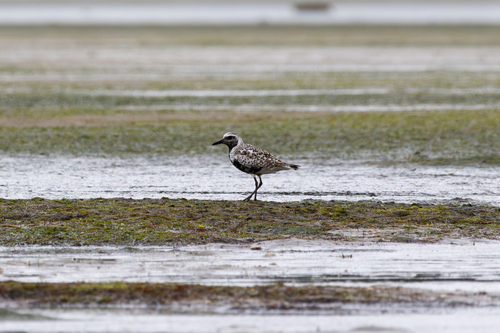
Grey Plover
European Golden Plover
In short
The Grey Plover (Pluvialis squatarola) and the European Golden Plover (Pluvialis apricaria) are both shorebird species with notable differences in plumage, habitat preference, and vocalizations. The Grey Plover is larger, often with a more uniform grey coloration, while the European Golden Plover has distinctive golden speckling and prefers more open grassland habitats.
Identification tips
- Birds of the World Similar-Species Diagnostics:
-
The expert source mentions that the Grey Plover has a "striking black face and belly" in breeding plumage, while the European Golden Plover is noted for its "golden speckling" on its plumage, particularly in breeding season. This indicates a clear field mark to distinguish them based on color and pattern.
-
AI Field Diagnostics:
- Size and Shape: Look for the larger, bulkier body of the Grey Plover compared to the more slender European Golden Plover. This size difference can be helpful in identification.
- Plumage Colors: Pay close attention to the plumage; if you see a bird with golden speckles, it is likely the European Golden Plover. The Grey Plover will appear more uniformly grey or black and white in contrast.
- Behavior: The Grey Plover is often more solitary, so if you spot a large group of plovers, they’re likely European Golden Plovers. The Grey Plover’s quick stop-and-go foraging behavior can also be a distinguishing factor.
- Habitat: If you're at a coastal site, you are more likely to see Grey Plovers, while European Golden Plovers are typically found in more inland, grassy areas.
- Vocalization: Listen for the call; if you hear a sharp, high-pitched series of sounds, it’s likely a Grey Plover. In contrast, the Golden Plover's call is more melodic and softer.
By focusing on these distinctive traits, birdwatchers can confidently identify and differentiate between the Grey Plover and the European Golden Plover in the field.
Size
- Grey Plover: Generally larger, measuring about 28-30 cm in length with a wingspan of 66-70 cm. It has a more robust body structure.
- European Golden Plover: Slightly smaller, measuring approximately 25-27 cm in length with a wingspan of around 60-70 cm. Its body is more slender compared to the Grey Plover.
Plumage
- Grey Plover: During breeding, it showcases a striking black face and belly with a white mantle. In non-breeding plumage, it turns a more muted grey and brown, giving it a less distinctive appearance.
- European Golden Plover: Recognized for its stunning golden-brown speckled plumage, particularly during the breeding season. In winter, it also appears more muted but retains a more distinct golden hue compared to the Grey Plover.
Behaviour
- Grey Plover: Often seen foraging alone or in small groups. It has a distinctive behavior of running quickly and stopping suddenly while foraging.
- European Golden Plover: More sociable, often found in larger flocks, particularly during migration. It has a characteristic “swimming” flight pattern, with wings held high and a rapid, undulating motion.
Habitat
- Grey Plover: Prefers coastal habitats, such as mudflats, sandy shores, and estuaries. It is often found in intertidal zones.
- European Golden Plover: Typically found in open grasslands, moors, and fields, especially during the breeding season. It is less tied to coastal environments compared to the Grey Plover.
Voice
- Grey Plover: Produces a distinctive series of sharp, high-pitched calls, which can be described as “klee-klee-klee” sounds.
- European Golden Plover: Has a more melodious call, often described as a “pee pee” sound, which is softer and more melodic than that of the Grey Plover.