Birdr

Grey-rumped Swift vs Band-rumped Swift

Chaetura cinereiventris versus Chaetura spinicaudus

Play a quiz with Grey-rumped Swift and Band-rumped Swift

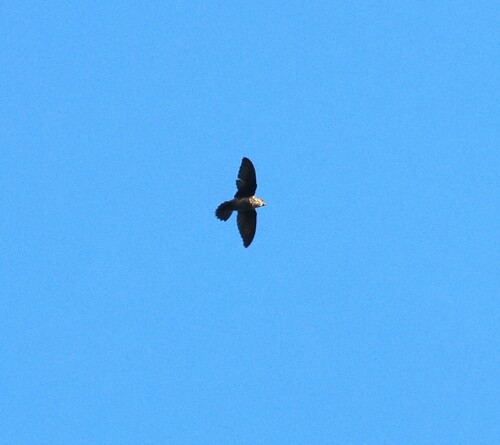
Grey-rumped Swift (Chaetura cinereiventris) Grey-rumped Swift
Band-rumped Swift (Chaetura spinicaudus) Band-rumped Swift

Media

Loading…

In short

The Grey-rumped Swift and Band-rumped Swift can be distinguished by their rump coloration and body shape. The Grey-rumped Swift has a large grey rump patch, while the Band-rumped Swift features a narrow, often bright white rump band. The Band-rumped Swift also has a more rakish, narrow-bodied shape.

Identification tips

  1. Look for the rump coloration: Grey-rumped Swifts have a large grey patch, while Band-rumped Swifts have a narrow white band. 2. Observe the body shape: Band-rumped Swifts are more slender and rakish. 3. Consider the habitat: Grey-rumped Swifts prefer forested areas, whereas Band-rumped Swifts are often seen over water. 4. Note the feeding behavior: Band-rumped Swifts frequently join mixed-species flocks.

Size

Both species are similar in size, but the Band-rumped Swift appears more slender and narrow-bodied.

Plumage

The Grey-rumped Swift has a large grey rump patch and a pale throat, whereas the Band-rumped Swift has a narrow white rump band that can sometimes appear greyish in certain subspecies.

Behaviour

The Band-rumped Swift often feeds over water and joins mixed-species flocks, while the Grey-rumped Swift is more commonly found over forested habitats.

Habitat

Grey-rumped Swifts are typically found in lowland and foothill forests, often nesting in chimneys or similar structures. Band-rumped Swifts are more widespread and can be found up to 1500 m, often near water.

Submit a better description

Use the same sections as the comparison. Your text is published immediately.

The Grey-rumped Swift and Band-rumped Swift can be distinguished by their rump coloration and body shape. The Grey-rumped Swift has a large grey rump patch, while the Band-rumped Swift features a narrow, often bright white rump band. The Band-rumped Swift also has a more rakish, narrow-bodied shape.

  1. Look for the rump coloration: Grey-rumped Swifts have a large grey patch, while Band-rumped Swifts have a narrow white band. 2. Observe the body shape: Band-rumped Swifts are more slender and rakish. 3. Consider the habitat: Grey-rumped Swifts prefer forested areas, whereas Band-rumped Swifts are often seen over water. 4. Note the feeding behavior: Band-rumped Swifts frequently join mixed-species flocks.

Both species are similar in size, but the Band-rumped Swift appears more slender and narrow-bodied.

The Grey-rumped Swift has a large grey rump patch and a pale throat, whereas the Band-rumped Swift has a narrow white rump band that can sometimes appear greyish in certain subspecies.

The Band-rumped Swift often feeds over water and joins mixed-species flocks, while the Grey-rumped Swift is more commonly found over forested habitats.

Grey-rumped Swifts are typically found in lowland and foothill forests, often nesting in chimneys or similar structures. Band-rumped Swifts are more widespread and can be found up to 1500 m, often near water.

Discard your changes?

You have unsaved edits. If you leave now, those changes will be lost.

Grey-rumped Swift · Band-rumped Swift · My Tricky Birds