Birdr

Grey Silky-flycatcher vs Phainopepla

Ptiliogonys cinereus versus Phainopepla nitens

Play a quiz with Grey Silky-flycatcher and Phainopepla
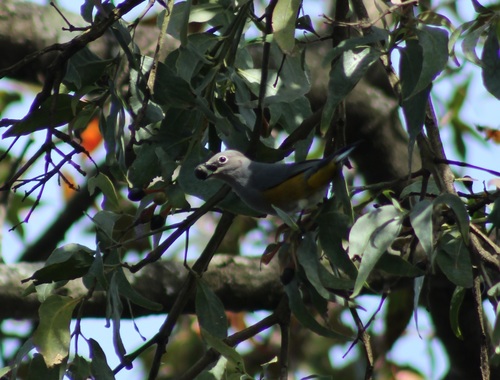
Grey Silky-flycatcher (Ptiliogonys cinereus) Grey Silky-flycatcher
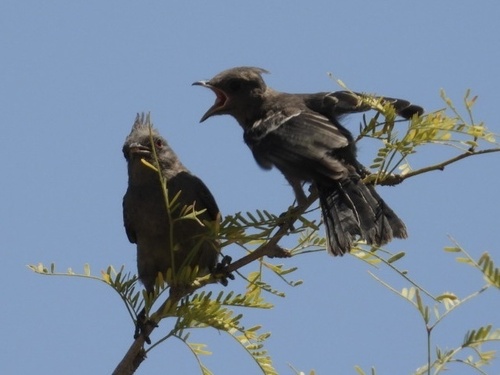
Phainopepla (Phainopepla nitens) Phainopepla

Media

Loading…

In short

The Grey Silky-flycatcher and Phainopepla are both members of the silky-flycatcher family, but they can be distinguished by their plumage and behavior. The Grey Silky-flycatcher has a more uniform grey appearance, while the male Phainopepla is glossy black with striking white wing patches visible in flight. Observing their habitat and behavior can also aid in identification.

Identification tips

  1. Look for the white wing patches in male Phainopeplas during flight. 2. Note the uniform grey of the Grey Silky-flycatcher compared to the glossy black of male Phainopeplas. 3. Observe habitat: Phainopeplas may be in desert or woodland areas depending on the season, while Grey Silky-flycatchers prefer montane forests. 4. Listen for the Phainopepla's soft, rising call.

Size

Both species are similar in size, but the Phainopepla may appear slightly more slender due to its longer tail and more streamlined body.

Plumage

The Grey Silky-flycatcher is predominantly grey, with a subtle crest and no significant color contrasts. In contrast, the male Phainopepla is glossy black with noticeable white wing patches, while the female is a more subdued grey-brown.

Behaviour

Phainopeplas are known for their distinctive fluttering and zigzag flight patterns, especially when pursuing insects. Grey Silky-flycatchers are less conspicuous in flight behavior.

Habitat

Grey Silky-flycatchers are typically found in montane forests, while Phainopeplas breed in both desert and woodland habitats, often moving between these as seasons change.

Voice

Phainopeplas have a distinctive call that is often described as a soft, rising 'wurp', while the Grey Silky-flycatcher's vocalizations are less frequently noted in field guides.

Submit a better description

Use the same sections as the comparison. Your text is published immediately.

The Grey Silky-flycatcher and Phainopepla are both members of the silky-flycatcher family, but they can be distinguished by their plumage and behavior. The Grey Silky-flycatcher has a more uniform grey appearance, while the male Phainopepla is glossy black with striking white wing patches visible in flight. Observing their habitat and behavior can also aid in identification.

  1. Look for the white wing patches in male Phainopeplas during flight. 2. Note the uniform grey of the Grey Silky-flycatcher compared to the glossy black of male Phainopeplas. 3. Observe habitat: Phainopeplas may be in desert or woodland areas depending on the season, while Grey Silky-flycatchers prefer montane forests. 4. Listen for the Phainopepla's soft, rising call.

Both species are similar in size, but the Phainopepla may appear slightly more slender due to its longer tail and more streamlined body.

The Grey Silky-flycatcher is predominantly grey, with a subtle crest and no significant color contrasts. In contrast, the male Phainopepla is glossy black with noticeable white wing patches, while the female is a more subdued grey-brown.

Phainopeplas are known for their distinctive fluttering and zigzag flight patterns, especially when pursuing insects. Grey Silky-flycatchers are less conspicuous in flight behavior.

Grey Silky-flycatchers are typically found in montane forests, while Phainopeplas breed in both desert and woodland habitats, often moving between these as seasons change.

Phainopeplas have a distinctive call that is often described as a soft, rising 'wurp', while the Grey Silky-flycatcher's vocalizations are less frequently noted in field guides.

Discard your changes?

You have unsaved edits. If you leave now, those changes will be lost.

Grey Silky-flycatcher · Phainopepla · My Tricky Birds