Grey-tailed Tattler vs Wandering Tattler
Tringa brevipes versus Tringa incana
Play a quiz with Grey-tailed Tattler and Wandering Tattler
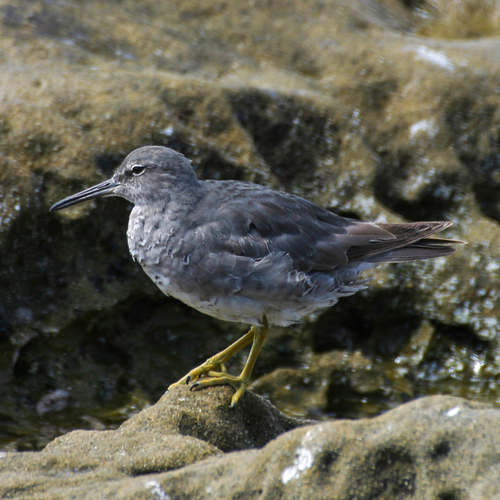
Wandering Tattler
In short
The Grey-tailed Tattler and Wandering Tattler are similar shorebirds best distinguished by their vocalizations and subtle plumage differences. Both species have similar structure, but the Grey-tailed Tattler often shows a more distinct supercilium and paler underparts.
Identification tips
- Listen for calls: Grey-tailed Tattler has a rapid trill; Wandering Tattler has slower whistles.
- Check supercilium: Grey-tailed Tattler's is longer and more pronounced.
- Look at underparts: Grey-tailed Tattler is paler with less barring.
- Observe habitat: Wandering Tattler prefers rocky shores; Grey-tailed Tattler is more estuarine.
- Note behavior: Both are solitary or in small groups, often on coastal mudflats or rocky areas.
Size
Both species are similar in size, typical of medium-sized shorebirds.
Plumage
The Grey-tailed Tattler generally has a more pronounced and longer white supercilium that extends behind the eye, especially in non-breeding plumage. Its underparts are paler with less barring compared to the Wandering Tattler, which has more extensive barring on the underparts during breeding season.
Behaviour
Both species exhibit similar behaviors, often seen foraging along rocky shores and mudflats. They are solitary or found in small groups.
Habitat
Both species frequent coastal areas, but the Grey-tailed Tattler is more often found in estuarine environments, while the Wandering Tattler prefers rocky coastlines.
Voice
The Grey-tailed Tattler's call is a rapid, high-pitched trill, whereas the Wandering Tattler has a lower-pitched, slower series of whistles. These vocal differences are often the most reliable field marks.