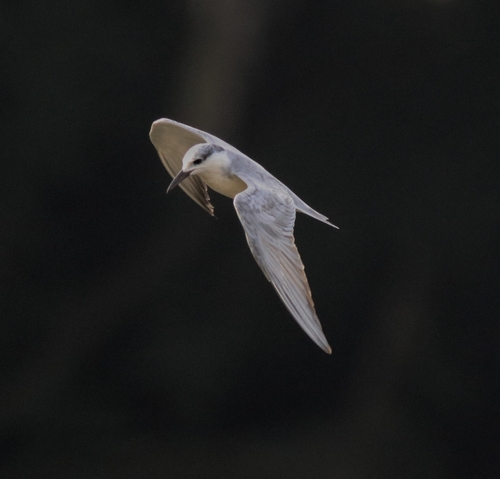
Gull-billed Tern vs Whiskered Tern
Gelochelidon nilotica versus Chlidonias hybrida
Play a quiz with Gull-billed Tern and Whiskered Tern

Gull-billed Tern
Whiskered Tern
In short
The Whiskered Tern (Chlidonias hybrida) and the Gull-billed Tern (Gelochelidon nilotica) are both medium-sized terns but can be distinguished by their bill shape, plumage coloration, and foraging behavior. The Whiskered Tern has a more slender build with a distinctive black cap and contrasting white cheeks, while the Gull-billed Tern features a stout black bill and a more robust body with pale gray upperparts.
Identification tips
- Birds of the World Similar-Species Diagnostics:
-
The Gull-billed Tern can be distinguished from the Australian Tern due to its straight-looking bill and contrasting upperparts. The Australian Tern has a more curved bill and paler gray upperparts that shade smoothly into the tail. The black on the face of the Australian Tern is more extensive than in the Gull-billed Tern, making it easier to identify during plumage changes (Molina et al., 2023).
-
AI Field Diagnostics:
- Bill Shape: The most noticeable difference is in bill shape. The Whiskered Tern has a thinner, more delicate bill, while the Gull-billed Tern has a stout, straight black bill.
- Plumage Color: In breeding plumage, the Whiskered Tern's black cap and white cheeks are striking, while the Gull-billed Tern's black cap can be less distinct or absent in non-breeding individuals. The overall coloration of the Gull-billed Tern is more uniform, appearing whiter-headed.
- Body Structure: The Gull-billed Tern is stockier and heavier than the Whiskered Tern, which is more slender and agile in flight.
- Flight Patterns: Observe their flight; the Whiskered Tern often has a fluttering flight style and is more agile, while the Gull-billed Tern exhibits a more buoyant and slower wing beat.
- Habitat Preference: Pay attention to their habitats. The Whiskered Tern is more likely to be found near freshwater bodies, while the Gull-billed Tern can be seen in a wider range of environments, including coastal areas.
By focusing on these key differences, birdwatchers can effectively distinguish between the Whiskered Tern and the Gull-billed Tern in their respective habitats.
Size
- Whiskered Tern: Measures 23-29 cm in length, weighs 60-101 g (mean 84 g), and has a wingspan of 64-70 cm. It is slender and medium-small in size.
- Gull-billed Tern: Larger than the Whiskered Tern, measuring 33-38 cm long, weighing 160-369 g, with a wingspan of 85-115 cm. It has a stocky build.
Plumage
- Whiskered Tern: Breeding adults have a black crown with contrasting white cheeks, mid-gray upperparts, and darker gray underparts. Non-breeding adults are very pale with dark flecking on the crown and a less contrasting pattern than the common tern.
- Gull-billed Tern: Exhibits pale gray upperparts and a stout black bill. In breeding plumage, adults have a black cap, while basic-plumaged birds lack this feature. The tail is short and slightly forked, and the body is predominantly white with a smooth transition from back to tail.
Behaviour
- Whiskered Tern: Known for its aerial-dipping feeding style, often fluttering above water before swooping down to catch prey. Its feeding habits are more varied, including hawking insects over fields and occasionally feeding at sea.
- Gull-billed Tern: Characterized by its buoyant flight and slower wing beats. It primarily feeds on small fish and insects, often seen foraging near shorelines and wetlands.
Habitat
- Whiskered Tern: Prefers freshwater habitats, including lakes, marshes, and rivers, typically foraging within 1 km of its breeding colony but can range up to 9 km.
- Gull-billed Tern: Found in a variety of habitats including coastal areas, estuaries, and inland wetlands, with a broader distribution that can range from freshwater to saltwater environments.
Voice
- Whiskered Tern: Its vocalizations include a harsh advertising call described as a rasping “kyick” or “cherk,” and an alarm call that is a louder “kerch.” Young birds produce a loud “chee chee” call when soliciting food.
- Gull-billed Tern: Vocalizations are less documented in comparison, but they typically have a more subdued call than the Whiskered Tern.