Gunnison Sage-Grouse vs Common Pheasant
Centrocercus minimus versus Phasianus colchicus
Play a quiz with Gunnison Sage-Grouse and Common Pheasant
Gunnison Sage-Grouse
Common Pheasant
In short
The Gunnison Sage-Grouse and Common Pheasant are both ground-dwelling birds but differ significantly in appearance and habitat. The Gunnison Sage-Grouse is native to sagebrush ecosystems in the U.S., while the Common Pheasant is an introduced species found in a variety of habitats, often near agricultural areas.
Identification tips
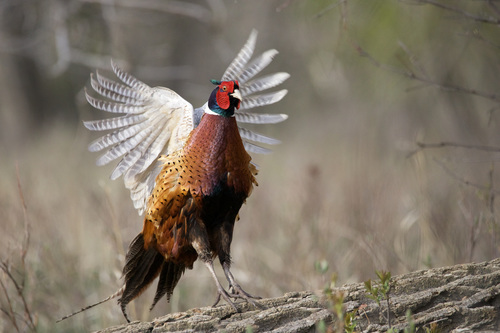
1. Look for the Gunnison Sage-Grouse in sagebrush areas; they are unlikely to be found in agricultural fields where pheasants thrive. 2. Observe the male plumage: Gunnison Sage-Grouse males have black bellies and unique tail feathers, while male pheasants have iridescent plumage with a white neck ring. 3. Listen for vocalizations: Gunnison Sage-Grouse have popping sounds during displays, contrasting with the pheasant's crowing calls.
Size
The Gunnison Sage-Grouse is generally larger and bulkier than the Common Pheasant, with males of the former being particularly robust during display.
Plumage
Gunnison Sage-Grouse males have distinctive black bellies and elaborate tail feathers with white-tipped filaments, while Common Pheasants have iridescent plumage with a prominent white neck ring in males. Females of both species are more cryptically colored, but pheasant females have a more uniform brown appearance.
Behaviour
Gunnison Sage-Grouse are known for their elaborate lekking displays, where males gather to perform for females. Common Pheasants do not lek and are more solitary or found in small groups, especially outside the breeding season.
Habitat
Gunnison Sage-Grouse are restricted to sagebrush habitats, whereas Common Pheasants are highly adaptable and can be found in agricultural fields, grasslands, and woodlands.
Voice
Gunnison Sage-Grouse males produce a distinctive series of popping sounds during their display, while Common Pheasants are known for their loud, harsh crowing calls.