Birdr

Gurney's Sugarbird vs Cape Sugarbird

Promerops gurneyi versus Promerops cafer

Play a quiz with Gurney's Sugarbird and Cape Sugarbird
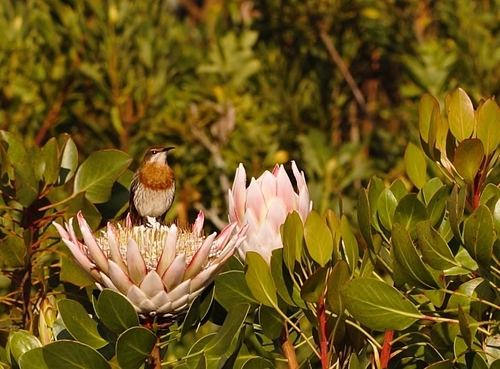
Gurney's Sugarbird (Promerops gurneyi) Gurney's Sugarbird
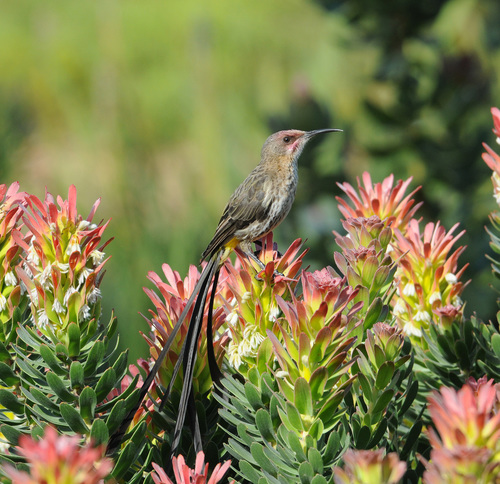
Cape Sugarbird (Promerops cafer) Cape Sugarbird

Media

Loading…

In short

Gurney's Sugarbird and Cape Sugarbird are similar long-tailed nectar feeders, but differ in tail length and plumage details. Gurney's has a shorter tail and more uniform coloration, while Cape has a longer tail and distinctive white edges on tail feathers.

Identification tips

  1. Look for the tail: Gurney's is shorter and less contrasting. 2. Check for white edges on the tail feathers, which are more prominent in the Cape Sugarbird. 3. Consider habitat: Gurney's may be in protea plantations, while Cape is in fynbos.

Size

Gurney's Sugarbird has a slightly shorter tail compared to the Cape Sugarbird, making it appear more compact.

Plumage

Gurney's Sugarbird is more uniformly colored with less contrast, whereas the Cape Sugarbird has prominent white edges on its tail feathers and a more contrasting plumage.

Behaviour

Both species exhibit similar feeding behaviors, often seen hovering around flowers for nectar.

Habitat

Gurney's Sugarbird is found in protea-rich areas and has adapted to commercial protea plantations, while Cape Sugarbird is more strictly associated with fynbos habitats.

Voice

Vocalizations are similar and not a reliable distinguishing feature in the field.

Submit a better description

Use the same sections as the comparison. Your text is published immediately.

Gurney's Sugarbird and Cape Sugarbird are similar long-tailed nectar feeders, but differ in tail length and plumage details. Gurney's has a shorter tail and more uniform coloration, while Cape has a longer tail and distinctive white edges on tail feathers.

  1. Look for the tail: Gurney's is shorter and less contrasting. 2. Check for white edges on the tail feathers, which are more prominent in the Cape Sugarbird. 3. Consider habitat: Gurney's may be in protea plantations, while Cape is in fynbos.

Gurney's Sugarbird has a slightly shorter tail compared to the Cape Sugarbird, making it appear more compact.

Gurney's Sugarbird is more uniformly colored with less contrast, whereas the Cape Sugarbird has prominent white edges on its tail feathers and a more contrasting plumage.

Both species exhibit similar feeding behaviors, often seen hovering around flowers for nectar.

Gurney's Sugarbird is found in protea-rich areas and has adapted to commercial protea plantations, while Cape Sugarbird is more strictly associated with fynbos habitats.

Vocalizations are similar and not a reliable distinguishing feature in the field.

Discard your changes?

You have unsaved edits. If you leave now, those changes will be lost.

Gurney's Sugarbird · Cape Sugarbird · My Tricky Birds