Birdr

Hair-crested Drongo vs Black Paradise-Flycatcher

Dicrurus hottentottus versus Terpsiphone atrocaudata

Play a quiz with Hair-crested Drongo and Black Paradise-Flycatcher
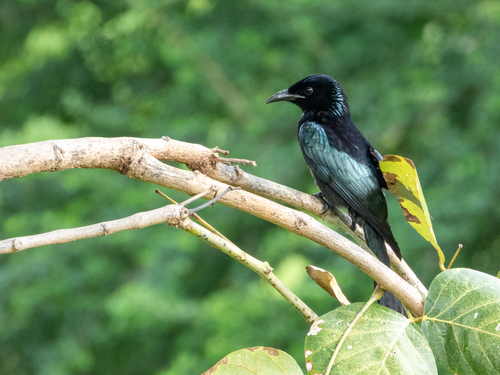
Hair-crested Drongo (Dicrurus hottentottus) Hair-crested Drongo
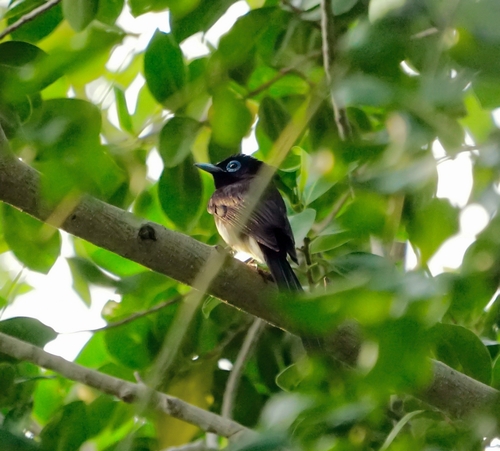
Black Paradise-Flycatcher (Terpsiphone atrocaudata) Black Paradise-Flycatcher

Media

Loading…

In short

The Hair-crested Drongo and Black Paradise-Flycatcher can be distinguished by their tail structure and plumage. The Drongo has a forked tail with a metallic sheen, while the Flycatcher has a long, straight tail and lacks the metallic gloss. Both species are dark overall, but their behavior and habitat preferences can also aid identification.

Identification tips

  1. Look for the forked tail of the Hair-crested Drongo versus the long, straight tail of the Black Paradise-Flycatcher. 2. Note the metallic sheen on the Drongo's plumage. 3. Observe behavior: Drongos are more likely to perch openly. 4. Consider habitat: Drongos are more often in open areas, while Flycatchers prefer dense forests.

Size

Both species are similar in size, but the Black Paradise-Flycatcher often appears more slender due to its longer tail.

Plumage

The Hair-crested Drongo has a less deep black color with a greenish metallic hue, while the Black Paradise-Flycatcher is uniformly dark without the metallic sheen. The Drongo's tail is distinctly forked, whereas the Flycatcher's tail is long and straight.

Behaviour

The Hair-crested Drongo is often seen perching conspicuously and sallying for insects, while the Black Paradise-Flycatcher may be more elusive, often found in dense foliage.

Habitat

Both species can be found in forested areas, but the Hair-crested Drongo is more adaptable to open and edge habitats, whereas the Black Paradise-Flycatcher prefers denser forest environments.

Voice

Vocalizations are not well-documented in the provided notes, but generally, drongos have a more varied and complex vocal repertoire compared to flycatchers.

Submit a better description

Use the same sections as the comparison. Your text is published immediately.

The Hair-crested Drongo and Black Paradise-Flycatcher can be distinguished by their tail structure and plumage. The Drongo has a forked tail with a metallic sheen, while the Flycatcher has a long, straight tail and lacks the metallic gloss. Both species are dark overall, but their behavior and habitat preferences can also aid identification.

  1. Look for the forked tail of the Hair-crested Drongo versus the long, straight tail of the Black Paradise-Flycatcher. 2. Note the metallic sheen on the Drongo's plumage. 3. Observe behavior: Drongos are more likely to perch openly. 4. Consider habitat: Drongos are more often in open areas, while Flycatchers prefer dense forests.

Both species are similar in size, but the Black Paradise-Flycatcher often appears more slender due to its longer tail.

The Hair-crested Drongo has a less deep black color with a greenish metallic hue, while the Black Paradise-Flycatcher is uniformly dark without the metallic sheen. The Drongo's tail is distinctly forked, whereas the Flycatcher's tail is long and straight.

The Hair-crested Drongo is often seen perching conspicuously and sallying for insects, while the Black Paradise-Flycatcher may be more elusive, often found in dense foliage.

Both species can be found in forested areas, but the Hair-crested Drongo is more adaptable to open and edge habitats, whereas the Black Paradise-Flycatcher prefers denser forest environments.

Vocalizations are not well-documented in the provided notes, but generally, drongos have a more varied and complex vocal repertoire compared to flycatchers.

Discard your changes?

You have unsaved edits. If you leave now, those changes will be lost.

Hair-crested Drongo · Black Paradise-Flycatcher · My Tricky Birds