
Hair-crested Drongo vs Greater Racket-tailed Drongo
Dicrurus hottentottus versus Dicrurus paradiseus
Play a quiz with Hair-crested Drongo and Greater Racket-tailed Drongo
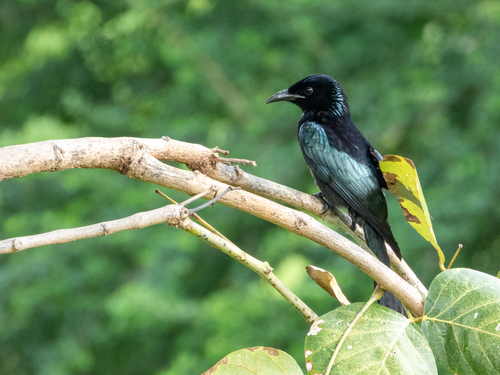 Hair-crested Drongo
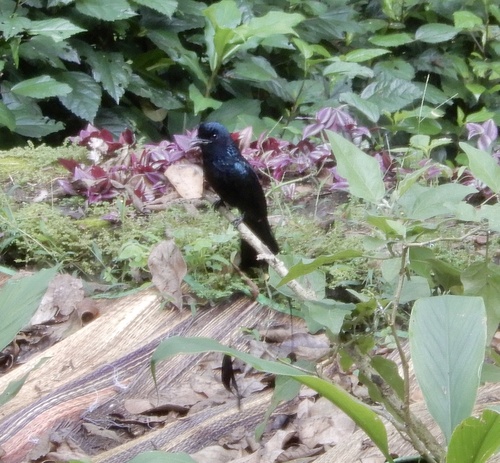 Greater Racket-tailed Drongo
In short
The most reliable way to separate Hair-crested Drongo from Greater Racket-tailed Drongo in the field is by the tail: Greater Racket-tailed Drongo shows dramatically elongated outer tail feathers ending in 'rackets' (spatulate tips), a feature never present on Hair-crested Drongo. This difference is visible in adults and most immatures except during molt or in very young birds. Both are glossy black drongos with some crest or hackle variation, but only Greater Racket-tailed Drongo can show a full, deeply forked tail with long rackets. Vocalizations also differ: Greater Racket-tailed Drongo is a master mimic with a huge, varied repertoire, while Hair-crested Drongo is less vocal and less likely to mimic. If you see a black drongo with a normal forked tail and no rackets, especially in the absence of extravagant vocal mimicry, it is almost certainly Hair-crested Drongo.
Identification tips
- Tail shape is the single most reliable mark: Greater Racket-tailed Drongo shows extremely long, outer tail feathers with webbing only at the tips, forming distinctive 'rackets.' Hair-crested Drongo never shows these. This mark is visible in adults and most immatures, but can be missing in very young or molting birds.
- Crest and hackles: Both species can show some crest or hackle, but Greater Racket-tailed Drongo (especially some subspecies) may have a more prominent, glossy crest or neck hackles. However, this is variable and not always reliable, as some populations and young birds lack a crest.
- Body gloss: Both are glossy black; this is not a useful separation mark.
- Juvenile/immature plumage: Young Greater Racket-tailed Drongos are duller and may lack a crest, but the tail is still longer and more graduated than Hair-crested Drongo. Hair-crested Drongo juveniles resemble adults but never show racket tails.
- Flight silhouette: In flight, Greater Racket-tailed Drongo's long rackets trail behind and are visible from a distance. Hair-crested Drongo has a more typical forked drongo tail.
- Perched posture: Both perch openly, but the racket-tailed drongo's tail often hangs well below the perch, sometimes swaying.
- Vocalizations: If the bird is giving a wide range of calls, especially imitations of other birds, it is almost certainly a Greater Racket-tailed Drongo. Hair-crested Drongo is much quieter and less varied in voice.
- Behavior in flocks: Greater Racket-tailed Drongo often joins mixed-species flocks and may act as a flock leader or kleptoparasite. Hair-crested Drongo is less likely to do so.
- Habitat context: Both can be found in forests, but if you are in dense forest and hear or see a highly vocal, conspicuous drongo, suspect Greater Racket-tailed Drongo.
- Size impression: Both are similar in body size, but Greater Racket-tailed Drongo appears larger due to its tail. Do not rely on size alone.
- Seasonal variation: During molt, Greater Racket-tailed Drongo may lack full rackets, making tail shape less reliable. In this case, rely more on voice and behavior.
- Subspecies variation: Some Greater Racket-tailed Drongo subspecies have reduced crests or hackles, so absence of a crest does not rule out this species if the tail is right.
- Confusion with other drongos: If the tail is not racketed and the bird is not especially vocal, Hair-crested Drongo is more likely, but beware of young or molting Greater Racket-tailed Drongos.
- Bill and structure: No clear differences are described in the sources; both have typical drongo bills.
- Pitfalls: The main pitfall is a young or molting Greater Racket-tailed Drongo lacking full rackets and crest—use behavior and voice as backup marks.
Size
Hair-crested Drongo has a recorded body mass of about 77 g [wikidata], which is within the typical range for medium-sized drongos. The Greater Racket-tailed Drongo is generally similar or slightly larger in overall impression, especially due to its extremely long tail streamers, but direct mass data is not provided. In the field, the difference in apparent size is often exaggerated by the racket-tailed drongo's tail, but their bodies are quite similar in bulk.
Plumage
Plumage differences are subtle in body coloration, as both species are glossy black. The key difference is in the tail: Greater Racket-tailed Drongo (adult and most immatures) has very long outer tail feathers with webbing only at the tips, forming 'rackets.' Young birds may lack full rackets or crest, but even then, the tail is longer and more graduated than in Hair-crested Drongo. Hair-crested Drongo never shows racket-tipped tail feathers; its tail is moderately forked, sometimes with a slight twist, but lacks the elongated streamers. Crest and hackle variation is complex in Greater Racket-tailed Drongo, with some subspecies showing prominent neck hackles or crests, but these features can overlap with the modest crest of Hair-crested Drongo. Juvenile Greater Racket-tailed Drongos are duller and may lack a crest, but the tail structure is still a strong clue. No distinctive age-specific upperwing pattern is described for either species in the sources.
Behaviour
Greater Racket-tailed Drongo is highly conspicuous, often perching in the open and drawing attention with its loud, varied calls and mimicry. It is known for joining mixed-species flocks and sometimes kleptoparasitizing other birds. Hair-crested Drongo is less conspicuous vocally and behaviorally, typically not engaging in such elaborate mimicry or flock-leading behavior. Both species perch openly, but the racket-tailed drongo's more extravagant tail and vocal presence make it stand out.
Habitat
Both species occur in Asian forested habitats, sometimes overlapping. Greater Racket-tailed Drongo is especially associated with dense forests and is often found in the canopy or at forest edges, where it is highly visible and audible. Hair-crested Drongo also inhabits forested areas but may be less tied to dense forest and is less likely to be the vocal centerpiece of mixed-species flocks.
Voice
Greater Racket-tailed Drongo is famous for its extremely varied and loud calls, including perfect imitations of many other birds, alarm calls, and context-sensitive mimicry. Its repertoire is broad, metallic, and includes whistles, nasal sounds, and complex phrases. Hair-crested Drongo is less vocal and does not engage in such extensive mimicry. If you hear a drongo producing a wide range of imitations and unusual sounds, it is almost certainly a Greater Racket-tailed Drongo.
Hair-crested Drongo · Greater Racket-tailed Drongo · My Tricky Birds