Birdr

Harris's Hawk vs Grey Hawk

Parabuteo unicinctus versus Buteo plagiatus

Play a quiz with Harris's Hawk and Grey Hawk
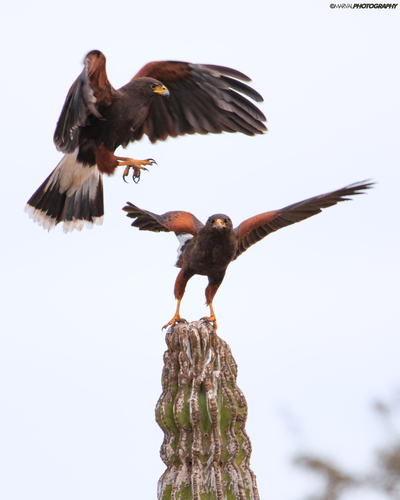
Harris's Hawk (Parabuteo unicinctus) Harris's Hawk
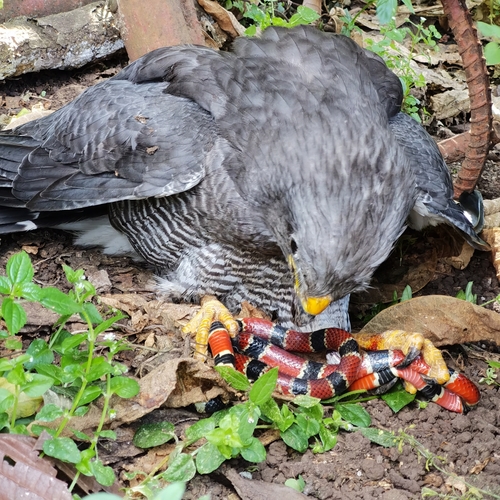
Grey Hawk (Buteo plagiatus) Grey Hawk

Media

Loading…

In short

The Grey Hawk (Buteo plagiatus) and Harris's Hawk (Parabuteo unicinctus) are both medium-sized raptors that exhibit distinct physical and behavioral traits, making them recognizable in the field. The Grey Hawk has a more uniform gray plumage with a unique white "U" pattern on the tail, while the Harris's Hawk is characterized by its striking tricolored plumage featuring chestnut and dark brown, along with a more elongated body shape.

Identification tips

  1. Birds of the World Similar-Species Diagnostics:
  2. "No other hawk has similar coloration. Dark-morph buteos (e.g., Swainson's Hawk) are closest but generally lack chestnut thighs, chestnut wing patches, and white on both tail-coverts and tail." (Harris's Hawk - Similar Species section)
  3. "Juvenile Harris's Hawk is similar to adult, except that breast and belly are streaked with cream or buffy coloration." (Harris's Hawk - Identification section)

  4. AI Field Diagnostics:

  5. Size and Proportions: The Harris's Hawk is generally larger and has a more elongated appearance due to its longer legs and tail, making it look lankier compared to the stockier Grey Hawk.
  6. Plumage Patterns: Pay attention to the plumage color—if you see a bird with a predominantly gray color with a white "U" shape on the tail, it's a Grey Hawk. In contrast, if you observe a dark brown bird with rusty chestnut patches and a sharply defined white tail base, you are looking at a Harris's Hawk.
  7. Flight Style: Observe the flight pattern; the Grey Hawk's flight is quicker and more fluttery, while the Harris's Hawk's flight is more buoyant and may reveal the striking white underwings.
  8. Behavioral Cues: If you see a hawk hunting alone, it’s more likely to be a Grey Hawk, whereas if multiple hawks are seen together hunting cooperatively, it's likely a Harris's Hawk.
  9. Habitat Preferences: Consider where you are observing the hawk. If you are in arid woodland or scrubby areas, both could potentially be present, but if you notice specific cooperative hunting or a more pronounced chestnut coloration, lean towards Harris's Hawk.

By focusing on these key differences in size, coloration, behavior, and habitat, birdwatchers can effectively distinguish between the Grey Hawk and Harris's Hawk in the field.

Size

Plumage

Behaviour

Habitat

Voice

Submit a better description

Use the same sections as the comparison. Your text is published immediately.

The Grey Hawk (Buteo plagiatus) and Harris's Hawk (Parabuteo unicinctus) are both medium-sized raptors that exhibit distinct physical and behavioral traits, making them recognizable in the field. The Grey Hawk has a more uniform gray plumage with a unique white "U" pattern on the tail, while the Harris's Hawk is characterized by its striking tricolored plumage featuring chestnut and dark brown, along with a more elongated body shape.

  1. Birds of the World Similar-Species Diagnostics:
  2. "No other hawk has similar coloration. Dark-morph buteos (e.g., Swainson's Hawk) are closest but generally lack chestnut thighs, chestnut wing patches, and white on both tail-coverts and tail." (Harris's Hawk - Similar Species section)
  3. "Juvenile Harris's Hawk is similar to adult, except that breast and belly are streaked with cream or buffy coloration." (Harris's Hawk - Identification section)

  4. AI Field Diagnostics:

  5. Size and Proportions: The Harris's Hawk is generally larger and has a more elongated appearance due to its longer legs and tail, making it look lankier compared to the stockier Grey Hawk.
  6. Plumage Patterns: Pay attention to the plumage color—if you see a bird with a predominantly gray color with a white "U" shape on the tail, it's a Grey Hawk. In contrast, if you observe a dark brown bird with rusty chestnut patches and a sharply defined white tail base, you are looking at a Harris's Hawk.
  7. Flight Style: Observe the flight pattern; the Grey Hawk's flight is quicker and more fluttery, while the Harris's Hawk's flight is more buoyant and may reveal the striking white underwings.
  8. Behavioral Cues: If you see a hawk hunting alone, it’s more likely to be a Grey Hawk, whereas if multiple hawks are seen together hunting cooperatively, it's likely a Harris's Hawk.
  9. Habitat Preferences: Consider where you are observing the hawk. If you are in arid woodland or scrubby areas, both could potentially be present, but if you notice specific cooperative hunting or a more pronounced chestnut coloration, lean towards Harris's Hawk.

By focusing on these key differences in size, coloration, behavior, and habitat, birdwatchers can effectively distinguish between the Grey Hawk and Harris's Hawk in the field.

  • Grey Hawk: Males average 429 g and measure about 41 cm in length; females are larger, averaging 628 g and about 44 cm long.
  • Harris's Hawk: Males weigh between 515-880 g and measure 46-59 cm long, with females significantly larger at 775-1,630 g. This size overlap could potentially complicate identification without careful observation.
  • Grey Hawk: Adults are medium gray with a finely barred gray and white underside. The tail is black with three white bands, including a distinctive white "U" shape at the base visible in both adults and juveniles.
  • Harris's Hawk: Adults are mostly chocolate brown with rusty chestnut on the wings and flanks, while the tail has a striking dark brown or almost black coloration with white at the base and terminal band. The juvenile plumage is similar but more streaked with lighter tones.
  • Grey Hawk: Exhibits an accipiter-like flight style, characterized by rapid wing beats followed by glides. It often hunts from a perch.
  • Harris's Hawk: Known for its cooperative hunting behavior, often seen hunting in groups. It has a more buoyant flight style with conspicuous white primaries visible during flight.
  • Grey Hawk: Prefers arid, open woodlands, and scrubby areas, often found in the southwestern United States to parts of Central America.
  • Harris's Hawk: Typically inhabits desert, scrub, and open woodlands, extending from the southwestern United States down through Central and South America.
  • Grey Hawk: Often described as having a sharp, high-pitched call, which can be distinctive when heard.
  • Harris's Hawk: Has a variety of vocalizations, including a series of barks or whistles, particularly during cooperative hunting.

Discard your changes?

You have unsaved edits. If you leave now, those changes will be lost.

Harris's Hawk · Grey Hawk · My Tricky Birds