Birdr

Hen Harrier vs Eurasian Goshawk

Circus cyaneus versus Astur gentilis

Play a quiz with Hen Harrier and Eurasian Goshawk
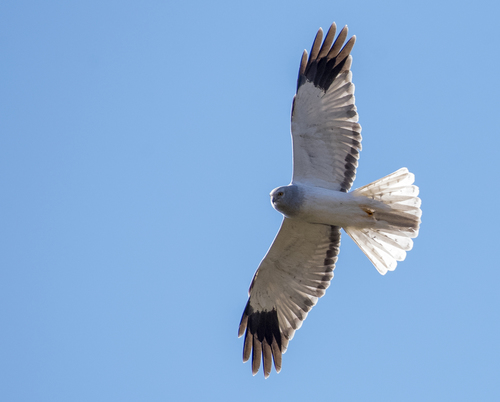
Hen Harrier (Circus cyaneus) Hen Harrier
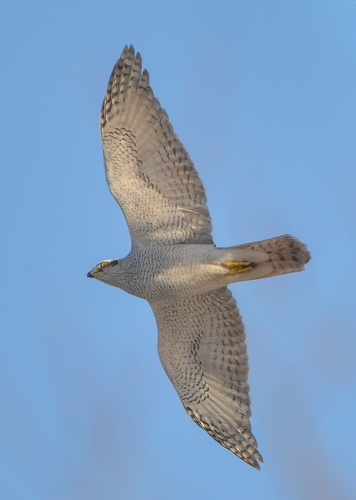
Eurasian Goshawk (Astur gentilis) Eurasian Goshawk

Media

Loading…

In short

The Hen Harrier and Eurasian Goshawk can be distinguished by their flight patterns and plumage. The Hen Harrier is known for its low, gliding flight with wings held in a shallow 'V', while the Goshawk has a more powerful, direct flight. Plumage differences are also notable, especially in males: Hen Harriers have a distinctive grey plumage with black wingtips, whereas Goshawks have a barred underbody and a more robust build.

Identification tips

  1. Flight pattern: Look for the Hen Harrier's low, gliding flight with wings in a shallow 'V'. 2. Plumage: Note the grey and black wingtips of male Hen Harriers versus the barred underbody of Goshawks. 3. Size and build: Goshawks are larger and more robust. 4. Habitat: Consider the environment; open fields suggest Hen Harrier, while forests suggest Goshawk. 5. Vocalizations: Listen for the Goshawk's calls, especially during breeding season.

Size

The Eurasian Goshawk is generally larger and more robust than the Hen Harrier, with a broader wingspan and bulkier body.

Plumage

Male Hen Harriers are grey with black wingtips, while females and juveniles are brown with a white rump. Goshawks have a greyish upper body with a barred underbody and a distinctive white supercilium above the eye.

Behaviour

Hen Harriers are often seen gliding low over open fields, whereas Goshawks are more likely to be seen flying through wooded areas with powerful wingbeats.

Habitat

Hen Harriers prefer open habitats like moorlands and marshes, while Goshawks are typically found in forested areas.

Voice

Hen Harriers are generally silent, especially outside the breeding season, while Goshawks have a variety of calls, including a loud, repetitive 'kak-kak-kak' during the breeding season.

Submit a better description

Use the same sections as the comparison. Your text is published immediately.

The Hen Harrier and Eurasian Goshawk can be distinguished by their flight patterns and plumage. The Hen Harrier is known for its low, gliding flight with wings held in a shallow 'V', while the Goshawk has a more powerful, direct flight. Plumage differences are also notable, especially in males: Hen Harriers have a distinctive grey plumage with black wingtips, whereas Goshawks have a barred underbody and a more robust build.

  1. Flight pattern: Look for the Hen Harrier's low, gliding flight with wings in a shallow 'V'. 2. Plumage: Note the grey and black wingtips of male Hen Harriers versus the barred underbody of Goshawks. 3. Size and build: Goshawks are larger and more robust. 4. Habitat: Consider the environment; open fields suggest Hen Harrier, while forests suggest Goshawk. 5. Vocalizations: Listen for the Goshawk's calls, especially during breeding season.

The Eurasian Goshawk is generally larger and more robust than the Hen Harrier, with a broader wingspan and bulkier body.

Male Hen Harriers are grey with black wingtips, while females and juveniles are brown with a white rump. Goshawks have a greyish upper body with a barred underbody and a distinctive white supercilium above the eye.

Hen Harriers are often seen gliding low over open fields, whereas Goshawks are more likely to be seen flying through wooded areas with powerful wingbeats.

Hen Harriers prefer open habitats like moorlands and marshes, while Goshawks are typically found in forested areas.

Hen Harriers are generally silent, especially outside the breeding season, while Goshawks have a variety of calls, including a loud, repetitive 'kak-kak-kak' during the breeding season.

Discard your changes?

You have unsaved edits. If you leave now, those changes will be lost.

Hen Harrier · Eurasian Goshawk · My Tricky Birds