
Hen Harrier vs Montagu's Harrier
Circus cyaneus versus Circus pygargus
Play a quiz with Hen Harrier and Montagu's Harrier
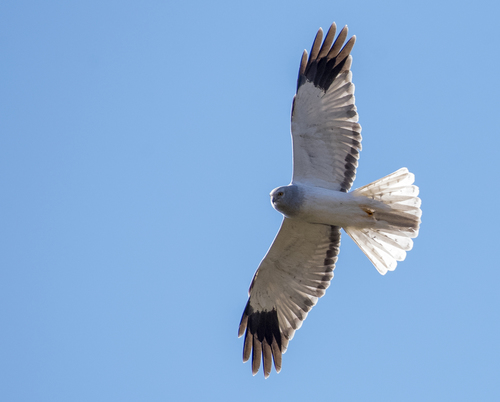 Hen Harrier
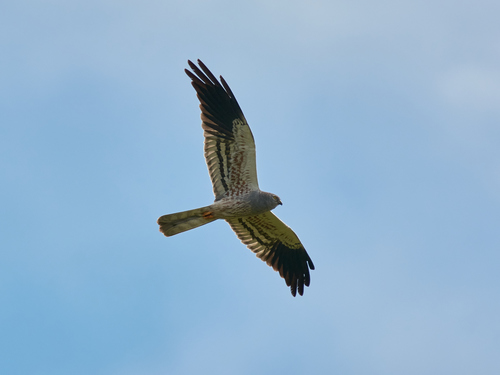 Montagu's Harrier
In short
The most reliable field mark to separate Hen Harrier from Montagu's Harrier in the field is overall structure and flight style: Montagu's is noticeably slimmer, with longer, narrower, and more pointed wings, and a more buoyant, elastic flight. Adult males are straightforward—Hen Harrier males are paler grey and cleaner below, while Montagu's males are darker and more mottled. Females and juveniles (the usual confusion) are trickier: focus on the more slender, tern-like look and flight of Montagu's, and the heavier, broader-winged, and more robust jizz of Hen. Both have a white rump, but Montagu's shows a longer tail and more pointed 'hands' in flight. Subtle plumage differences exist, but structure and flight are more reliable at distance or in poor light.
Identification tips
- Structure in flight (all ages/sexes): Montagu's Harrier is slimmer, with longer, narrower, and more pointed wings, and a longer tail; Hen Harrier is broader-winged, heavier-bodied, and more robust. This is the most reliable field mark at distance or in poor light.
- Flight style (all ages/sexes): Montagu's has a buoyant, elastic, almost tern-like flight with smooth, powerful wingbeats; Hen Harrier is steadier, heavier, and hugs the ground more closely.
- Adult male plumage: Hen Harrier males are pale grey above, white below (except grey upper breast), with black wingtips; Montagu's males are darker grey, more mottled, with black secondary bands and rusty streaks on the belly/flanks.
- Female/juvenile underparts: Hen Harrier females/juveniles have buff underparts with brown barring; Montagu's females have pale yellow-brown underparts with longitudinal stripes, and juveniles are more uniform red-brown below without spotting.
- Wing coverts (female/juvenile): Montagu's females have spotted wing coverts; Hen Harrier females/juveniles lack this spotting.
- Upperwing pattern (juveniles): Hen Harrier juveniles have dark brown secondaries and less-barred bellies; Montagu's juveniles are more uniform red-brown below and do not show the same secondary contrast.
- White rump (all ages): Both species show a white rump, but it is often more prominent on Hen Harrier females/juveniles; not a safe separator alone.
- Melanistic birds: Only Montagu's Harrier shows regular melanistic morphs (very dark birds); Hen Harrier does not.
- Bill and head: Not described as diagnostic in these sources.
- Vocalizations: Hen Harrier is notably vocal, especially females; Montagu's is not described as vocal in these sources.
- Habitat and season: In western Europe in winter, Hen Harrier is more likely; Montagu's is a summer visitor and absent in winter. In migration or breeding season, both may occur together.
- Size: Hen Harrier is heavier and bulkier; Montagu's is smaller and lighter, but beware overlap and distance effects.
- Perched birds: Structure is still helpful—Hen Harrier looks more robust and larger-headed, Montagu's more slender and long-tailed.
- Confusion risk: Females and juveniles are the main pitfall; always prioritize structure and flight style over plumage details unless the bird is seen well and at close range.
- When in doubt: If the bird looks especially slim, long-tailed, and flies with buoyant, elastic wingbeats, lean Montagu's; if broader, heavier, and more methodical, lean Hen.
Size
Hen Harrier is distinctly heavier and bulkier than Montagu's Harrier. Adult Hen Harriers average 436.5g (males ~350g, females ~530g), while Montagu's average 315.5g (males ~265g, females ~345g) [wikidata]. Hen Harrier also has a slightly longer wingspan (97–122 cm vs. 97–115 cm) and is longer overall (41–52 cm vs. 43–47 cm, but note overlap). In the field, Hen Harrier appears broader-winged and more robust, while Montagu's is slimmer and more delicate.
Plumage
Juveniles and females of both species are brown above with a white rump and buffy underparts, making them hard to separate by color alone. However, Hen Harrier females and juveniles show buff underparts with brown barring, and their secondaries are dark brown with less distinct barring in juveniles. Montagu's Harrier females have pale yellow-brown underparts with longitudinal stripes and spotted wing coverts; juveniles are more uniform red-brown below and lack the spotting of females. Adult males are easier: Hen Harrier males are pale grey above and white below with black wingtips, while Montagu's males are darker grey, more mottled, and have black secondary bands and rusty streaks on the belly and flanks. The white rump is present in both, but more obvious in Hen Harrier females and juveniles. Melanistic Montagu's Harriers (rare) are very dark and can be confusing, but are not matched by any Hen Harrier morph.
Behaviour
Both species hunt low over open ground with wings held in a shallow V, but Montagu's Harrier has a more graceful, elastic, and buoyant flight, with more tern-like wingbeats. Hen Harrier appears heavier and more methodical, hugging the ground more closely. Both circle and quarter fields, but Montagu's flight is smoother and lighter. Hen Harrier is notably vocal while hunting.
Habitat
Both species breed and hunt in open habitats such as marshes, grasslands, moorland, and farmland across Eurasia. Hen Harrier is more likely to be resident in milder western Europe (e.g., Britain, France), while Montagu's is a strict long-distance migrant, wintering in Africa and Asia. In winter, Hen Harrier may be found further north than Montagu's. Habitat alone is not diagnostic, but context (e.g., time of year, location) can help.
Voice
Hen Harrier is described as quite vocal, especially the female, who gives a whistled 'piih-eh' when receiving food and a rapid 'chit-it-it-it-it-et-it' alarm. The male gives a 'chek-chek-chek' and a bouncing 'chuk-uk-uk-uk' in display. No distinctive vocalizations are described for Montagu's Harrier in the sources, so voice is not a reliable separator.