
Hen Harrier vs Pallid Harrier
Circus cyaneus versus Circus macrourus
Play a quiz with Hen Harrier and Pallid Harrier
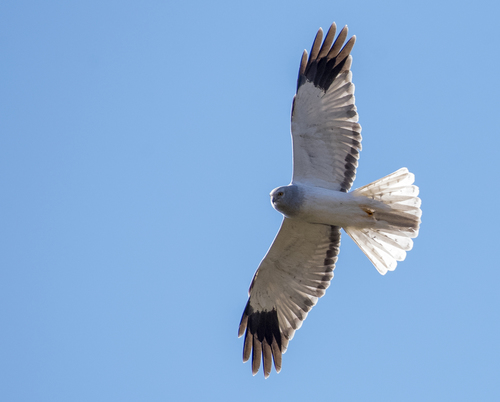 Hen Harrier
 Pallid Harrier
In short
The most reliable field mark between Hen Harrier and Pallid Harrier is the combination of wing shape and plumage in flight, especially on females and juveniles (the 'ringtails'). Pallid Harrier is smaller, slimmer, and has narrower wings than Hen Harrier, with a paler overall appearance and a more sharply defined facial pattern in females and juveniles. Adult males differ subtly: Pallid Harrier males are paler grey with narrower black wingtips, while Hen Harrier males are darker grey above with broader black wingtips. Both species show a white rump, but subtle differences in underpart barring and wingtip pattern are key, especially in immature birds. Structural and plumage details must be used together for confident separation, particularly outside the breeding season or when viewing ringtails.
Identification tips
- Wing Shape in Flight (all ages): Pallid Harrier has narrower, more pointed wings; Hen Harrier's wings are broader and more rectangular, especially obvious in gliding flight.
- Overall Structure: Hen Harrier appears bulkier and heavier, with a longer tail and broader 'hand' (outer primaries); Pallid Harrier is slimmer and lighter, with a more graceful, buoyant flight.
- Adult Male Plumage: Hen Harrier males are medium grey above with broad black wingtips; Pallid Harrier males are paler grey, almost whitish, with narrower black wingtips. Look for the extent and width of the black on the wingtips.
- Female/Juvenile Underparts: Hen Harrier females/juveniles have buff underparts with strong brown barring; Pallid Harrier females/juveniles are paler below, with fine brown streaking and a less marked belly.
- Facial Pattern (Females/Juveniles): Pallid Harrier shows a more sharply defined facial pattern with a pale collar and dark cheek, while Hen Harrier's face is plainer and less contrasting.
- Upperwing Pattern (Juveniles): Juvenile Hen Harrier has darker secondaries and less distinct barring on the belly; juvenile Pallid Harrier is paler with a more uniform, streaked look below.
- White Rump: Both species show a white rump, but this is not diagnostic between them; use in combination with other marks.
- Size: Hen Harrier is larger and heavier, but size overlap is considerable; use structure and plumage as primary cues.
- Habitat and Range: In western Europe, Hen Harrier is much more likely; Pallid Harrier is a rare vagrant. In eastern Europe and Asia, both may occur, so rely on field marks.
- Vocalizations: If you hear a whistled 'piih-eh' or 'chek-chek-chek' from a gliding harrier, Hen Harrier is likely; Pallid Harrier is generally silent.
- Flight Jizz: Pallid Harrier often appears more buoyant and agile due to its lighter build and narrower wings; Hen Harrier is steadier and more powerful in flight.
- Seasonal Context: In winter in western Europe, Hen Harrier is the default; Pallid Harrier is possible but rare. In migration or in eastern Europe/Asia, check all field marks carefully.
- Sexual Dimorphism: Both species show strong sexual dimorphism; always consider age and sex when identifying, as males and females differ markedly.
- Confusion with Montagu's Harrier: Both species' females/juveniles ('ringtails') are similar to Montagu's Harrier; Pallid Harrier is paler below with a more defined face than Montagu's, but this does not help separate it from Hen Harrier—focus on the contrasts above.
- Plumage Pitfalls: Lighting can wash out barring and streaking; always try to view underparts and facial pattern in good light, and use multiple features for confirmation.
Size
Hen Harrier is the larger and heavier species: average body mass is about 436.5 g versus 383.5 g for Pallid Harrier [wikidata]. Hen Harrier is also longer (41–52 cm vs 40–48 cm) and has a slightly greater wingspan (97–122 cm vs 95–120 cm). In the field, Hen Harrier appears bulkier and broader-winged, while Pallid Harrier is more slender and lighter built, with narrower, more pointed wings. Size overlap is significant, so structure and plumage are more reliable than size alone.
Plumage
-
Females and Juveniles ('ringtails'): Both are brown above with white upper tail coverts (white rump), but Pallid Harrier is paler below, with less barring and a more sharply defined facial pattern. Hen Harrier females/juveniles have buff underparts with strong brown barring, and their secondaries are darker and more extensively barred. Pallid Harrier's underparts are buff with fine brown streaking rather than barring, and the belly is noticeably paler. The facial pattern of Pallid Harrier is more contrasting, with a pale collar and well-marked dark cheek.
-
Adult Males: Hen Harrier males are medium grey above, white below (except for a grey upper breast), with broad black wingtips. Pallid Harrier males are paler grey above and white below, with narrower black wingtips. The overall impression is that Pallid Harrier males are paler and cleaner, with more limited black in the wingtips and narrower wings.
-
Upperwing in Flight (all ages): Hen Harrier shows broader wings and a more pronounced 'hand' (outer primaries), while Pallid Harrier's wings are narrower and more pointed. Juvenile Hen Harriers have darker secondaries and less distinct barring on the belly compared to adults, while juvenile Pallid Harriers maintain the paler, streaked look and a more defined facial pattern.
Behaviour
Both species hunt by flying low over open ground with wings held in a shallow V. Hen Harrier is typically more vocal during flight, especially near the nest. Both species hunt small mammals and birds, but Hen Harrier is more likely to be seen in western Europe and is more resident in milder regions, while Pallid Harrier is a rare vagrant there. Both use their owl-like facial disc to aid in hunting by sound. Behaviorally, differences are subtle, with Pallid Harrier sometimes appearing more buoyant and agile due to its lighter build.
Habitat
Hen Harrier breeds in open habitats such as marshes, grasslands, moorland, and farmland across Eurasia, and is resident or migratory depending on latitude. Pallid Harrier breeds further east (southern parts of eastern Europe, central Asia, Iran) and winters mainly in India and southeast Asia, only rarely appearing in western Europe as a vagrant. In areas of overlap, both can be found in similar open habitats, but Hen Harrier is much more likely in western Europe and the British Isles.
Voice
Hen Harrier is notably more vocal, especially females at the nest (whistled 'piih-eh' when receiving food, alarm 'chit-it-it-it-it-et-it'; males call 'chek-chek-chek' and 'chuk-uk-uk-uk' in display). Pallid Harrier's vocalizations are not described in the provided notes and are generally less frequently heard in the field, so voice is not a reliable separator unless Hen Harrier's distinctive calls are heard.