
Hermit Thrush vs Wood Thrush
Catharus guttatus versus Hylocichla mustelina
Play a quiz with Hermit Thrush and Wood Thrush
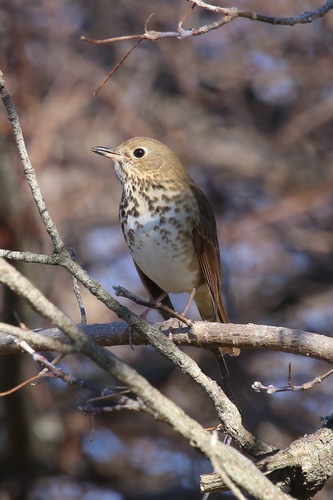 Hermit Thrush
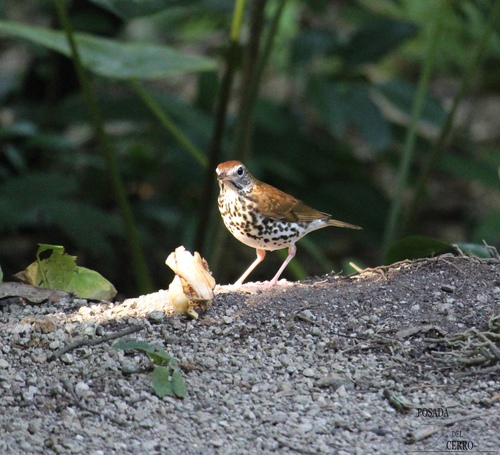 Wood Thrush
In short
The most reliable field mark to separate Hermit Thrush from Wood Thrush is size and spotting: Wood Thrush is noticeably larger and heavier-bodied, with bold, round, dark spots extending well onto the flanks and sides, while Hermit Thrush is smaller and slimmer, with finer, more restricted breast spotting and plainer flanks. Hermit Thrush also shows a contrasting reddish tail, especially when flicked, and a more compact, upright posture. Juveniles of Wood Thrush have extra spots on the upperparts, but both species show white eye rings and pinkish legs, so those features alone are not diagnostic. In flight, both show the Catharus-type underwing pattern, but Wood Thrush’s bulk and longer wingspan stand out. Listen for song only if the bird is singing, as both have beautiful, flute-like songs but with different structure.
Identification tips
- Size and build: Wood Thrush is much larger and bulkier than Hermit Thrush. If the bird looks nearly robin-sized, it is likely a Wood Thrush; Hermit Thrush is smaller and more slender.
- Spotting pattern: Wood Thrush has bold, round, dark spots that extend from the breast onto the sides and flanks, creating a heavily spotted look. Hermit Thrush has finer, neater spots mostly confined to the upper breast, with the belly and flanks much plainer.
- Tail color: Hermit Thrush shows a contrasting reddish or rufous tail, especially when the bird flicks its tail downward and then slowly raises it. Wood Thrush’s tail is brown, matching the wings and back, and does not contrast.
- Upperparts color: Wood Thrush has a warm, cinnamon-brown crown and upper back, with the rest of the upperparts duller brown. Hermit Thrush is more uniformly brown above, with eastern birds more olive-brown and western birds more gray-brown, but always with a rufous tail.
- Eye ring: Both species have white eye rings, but Hermit Thrush’s is often more sharply defined. This is not a reliable sole mark, as both show it.
- Bill: Wood Thrush has a slightly longer, heavier bill, but this is subtle and not always useful in the field.
- Leg color: Both have pinkish legs, so this is not useful for separation.
- Juvenile plumage: Juvenile Wood Thrushes have extra dark spots on the back, neck, and wing coverts, which Hermit Thrush never shows. If you see a thrush with dorsal spots, it is a juvenile Wood Thrush.
- Behavior: Hermit Thrush often flicks its reddish tail down and then slowly raises it—a classic behavior not shown by Wood Thrush. Wood Thrush tends to hop on the ground, flipping leaves, and is less likely to flick its tail.
- Posture: Hermit Thrush often appears more upright and alert, while Wood Thrush is bulkier and sits more horizontally.
- Habitat: In dense, mature, moist forest, especially in the East, Wood Thrush is more likely. In more open woods, coniferous forests, or edge habitats, Hermit Thrush is more likely, especially in migration.
- Flight: Both show the Catharus-type underwing pattern, but Wood Thrush’s larger size and broader wings are apparent in flight. No unique flight mark separates them.
- Song: Hermit Thrush’s song is ethereal, with a single note followed by descending phrases at different pitches. Wood Thrush’s song is richer, more rhythmic, and less airy. Use song only if you are confident in the differences.
- Season: Both species are migratory, but Hermit Thrush is more likely to be encountered in a wider range of habitats during migration and winter. Wood Thrush is more tied to mature forests in the breeding season.
- Pitfalls: Do not rely solely on eye ring or leg color, as both share these features. Spotting pattern, tail color, and size are the most reliable field marks.
Size
Wood Thrush is distinctly larger than Hermit Thrush in every dimension: 18–21.5 cm long (vs. 15–18 cm), wingspan 30–40 cm (vs. 25–30 cm), and mass 48–72 g (vs. 18–37 g). This difference is usually obvious in direct comparison or with experience, but can be subtle if seen alone. Wood Thrush looks bulkier and more robust, with a deeper chest and heavier bill, while Hermit Thrush appears more compact and slender. Wing chord and tarsus overlap, but Wood Thrush averages longer in both.
Plumage
- Juvenile/immature birds: Juvenile Wood Thrushes have additional bold spots on the back, neck, and wing coverts, which Hermit Thrush never shows at any age. Hermit Thrush juveniles resemble adults but lack these extra dorsal spots.
- Adults: Hermit Thrush is brown above with a distinctly reddish tail (especially obvious when flicked), white underparts with fine, neat dark spots on the breast, and plainer, grayish or brownish flanks. Wood Thrush has a rich cinnamon-brown crown and upper back, duller brown wings and tail, and underparts that are white with large, round, dark brown spots extending from the breast well onto the sides and flanks. Both have white eye rings and pink legs, but Hermit Thrush’s eye ring is often more crisply defined. Eastern Hermit Thrushes are more olive-brown above, western birds more gray-brown, but the reddish tail is always present.
- In flight: Both show the Catharus-type white-dark-white underwing pattern, but this is not diagnostic between these two. Wood Thrush’s larger size and broader wings are more apparent in flight.
Behaviour
Wood Thrush is typically solitary and forages mainly on the forest floor, flipping leaves to find insects, and often hops in leaf litter or on bare ground. Hermit Thrush is also solitary but may appear more upright and alert, often flicking its reddish tail downward and then slowly raising it—a classic behavior. Both may be seen foraging on the ground, but Hermit Thrush can also be found perching in mid-levels or lower branches, pausing between foraging bouts. Wood Thrush may defend winter feeding territories and can be aggressive in nest defense, showing wing and tail flicks or even strikes.
Habitat
Wood Thrush prefers mature, moist, deciduous or mixed forests with dense understory, often in larger tracts of forest. Hermit Thrush is more flexible, found in a variety of woodland types including coniferous, mixed, and deciduous forests, and is more likely to be seen in edge habitats or open understory. During migration, Hermit Thrush can occur in a wider range of wooded habitats, while Wood Thrush tends to stick to denser, mature forest even in migration.
Voice
Both species are famous for their beautiful, flute-like songs, but the structure differs. Hermit Thrush’s song starts with a clear introductory note followed by several ethereal, descending musical phrases, often in a minor key and repeated at different pitches. Wood Thrush’s song is also melodious and flute-like, but typically consists of a series of rich, clear phrases with a more rhythmic and less ethereal quality. Both sing from high, open perches, but song alone is not always diagnostic unless you are very familiar with both.