Birdr

Hooded Crow vs Common Raven

Corvus cornix versus Corvus corax

Play a quiz with Hooded Crow and Common Raven
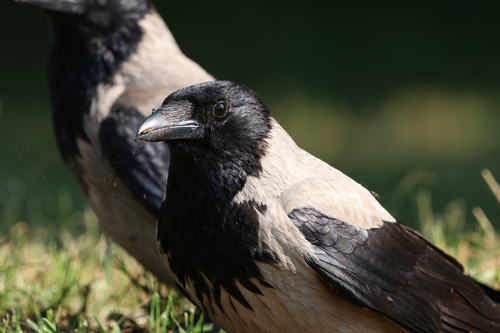
Hooded Crow (Corvus cornix) Hooded Crow
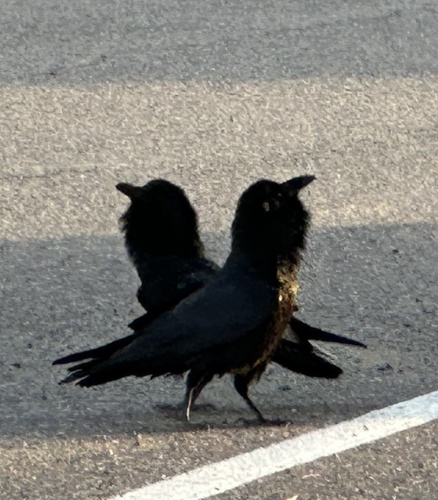
Common Raven (Corvus corax) Common Raven

Media

Loading…

In short

Hooded Crows are smaller and have a distinct pale gray body with black head, wings, and tail, while Common Ravens are larger with entirely black plumage. Common Ravens have a thicker bill and wedge-shaped tail, which are key structural differences. Both species are intelligent and adaptable, but their vocalizations and habitats can help differentiate them.

Identification tips

1. Size and Structure: Look for the larger size and thicker bill of the Common Raven. 2. Tail Shape: Note the wedge-shaped tail of the Raven compared to the square tail of the Hooded Crow. 3. Plumage: Observe the Hooded Crow's pale gray body contrasting with the Raven's all-black plumage. 4. Vocalization: Listen for the deep croak of the Raven versus the higher caw of the Crow. 5. Grouping: Hooded Crows often form larger groups, whereas Ravens are typically solitary or in pairs.

Size

Hooded Crow is smaller than the Common Raven.

Plumage

Hooded Crow has a pale gray body with black head, wings, and tail. Common Raven is entirely black.

Behaviour

Both species are intelligent and adaptable, often seen in urban and rural areas. Common Ravens are more likely to be seen alone or in pairs, while Hooded Crows can be found in larger groups.

Habitat

Hooded Crows are often found in open landscapes, urban areas, and agricultural fields. Common Ravens are more versatile, inhabiting a wide range of environments from forests to deserts.

Voice

Common Ravens have a deep, resonant croak, while Hooded Crows have a higher-pitched caw. Ravens' calls are more varied and complex.

Submit a better description

Use the same sections as the comparison. Your text is published immediately.

Hooded Crows are smaller and have a distinct pale gray body with black head, wings, and tail, while Common Ravens are larger with entirely black plumage. Common Ravens have a thicker bill and wedge-shaped tail, which are key structural differences. Both species are intelligent and adaptable, but their vocalizations and habitats can help differentiate them.

1. Size and Structure: Look for the larger size and thicker bill of the Common Raven. 2. Tail Shape: Note the wedge-shaped tail of the Raven compared to the square tail of the Hooded Crow. 3. Plumage: Observe the Hooded Crow's pale gray body contrasting with the Raven's all-black plumage. 4. Vocalization: Listen for the deep croak of the Raven versus the higher caw of the Crow. 5. Grouping: Hooded Crows often form larger groups, whereas Ravens are typically solitary or in pairs.

Hooded Crow is smaller than the Common Raven.

Hooded Crow has a pale gray body with black head, wings, and tail. Common Raven is entirely black.

Both species are intelligent and adaptable, often seen in urban and rural areas. Common Ravens are more likely to be seen alone or in pairs, while Hooded Crows can be found in larger groups.

Hooded Crows are often found in open landscapes, urban areas, and agricultural fields. Common Ravens are more versatile, inhabiting a wide range of environments from forests to deserts.

Common Ravens have a deep, resonant croak, while Hooded Crows have a higher-pitched caw. Ravens' calls are more varied and complex.

Discard your changes?

You have unsaved edits. If you leave now, those changes will be lost.

Hooded Crow · Common Raven · My Tricky Birds