Horsfield's Bronze-Cuckoo vs Banded Bay Cuckoo
Chalcites basalis versus Cacomantis sonneratii
Play a quiz with Horsfield's Bronze-Cuckoo and Banded Bay Cuckoo

Horsfield's Bronze-Cuckoo
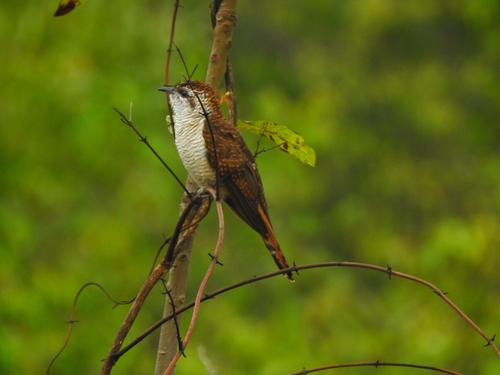
Banded Bay Cuckoo
In short
Horsfield's Bronze-Cuckoo and Banded Bay Cuckoo can be differentiated primarily by their plumage and vocalizations. The bronze-cuckoo has a distinctive bronze-green sheen on its back, while the banded bay cuckoo lacks this and has a more uniform rufous-brown coloration. Their calls are also notably different, aiding in identification.
Identification tips
Look for the bronze sheen on the back of Horsfield's Bronze-Cuckoo and listen for its high-pitched whistle. In contrast, note the rufous-brown plumage and descending whistle of the Banded Bay Cuckoo. Size and habitat preference can also provide clues.
Size
Horsfield's Bronze-Cuckoo is generally smaller and more compact compared to the Banded Bay Cuckoo.
Plumage
Horsfield's Bronze-Cuckoo features a bronze-green sheen on its back and a white underside with dark barring. In contrast, the Banded Bay Cuckoo has a more uniform rufous-brown plumage with a less contrasting underpart pattern.
Behaviour
Both species are known for their secretive behavior, often staying hidden in foliage. However, the Banded Bay Cuckoo may be more likely to be seen perching openly.
Habitat
Horsfield's Bronze-Cuckoo is typically found in open woodlands and scrublands, while the Banded Bay Cuckoo prefers denser forests and plantations.
Voice
Horsfield's Bronze-Cuckoo has a high-pitched, repetitive whistle, whereas the Banded Bay Cuckoo's call is a series of descending whistles. These vocal differences are key in distinguishing them.
Horsfield's Bronze-Cuckoo · Banded Bay Cuckoo · My Tricky Birds