Birdr

House Crow vs Hooded Crow

Corvus splendens versus Corvus cornix

Play a quiz with House Crow and Hooded Crow

House Crow (Corvus splendens) House Crow
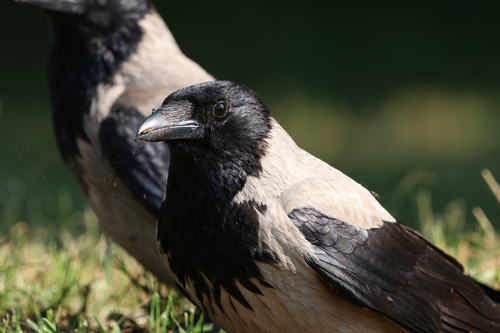
Hooded Crow (Corvus cornix) Hooded Crow

Media

Loading…

In short

The House Crow and Hooded Crow can be distinguished by their plumage and size. The House Crow has a more uniform dark appearance, while the Hooded Crow features a distinctive pale gray body with a contrasting black head, wings, and tail. Both species share similar habitats but differ in vocalizations and behavior.

Identification tips

1. Plumage: Look for the Hooded Crow's pale gray body contrasting with its black head and wings. 2. Size: Note that the House Crow is smaller. 3. Vocalization: Listen for the House Crow's nasal call compared to the Hooded Crow's deeper voice. 4. Behavior: Observe group size and noise level; House Crows are often in larger, noisier flocks.

Size

The House Crow is generally smaller than the Hooded Crow.

Plumage

The House Crow is mostly dark gray to black, with a slightly lighter nape and breast. In contrast, the Hooded Crow has a striking two-tone appearance with a pale gray body and black head, wings, and tail.

Behaviour

Both species are social and often found in urban areas, but the House Crow is more likely to be seen in larger, noisier groups.

Habitat

Both species are adaptable and can be found in urban and suburban areas, although the Hooded Crow is more widespread in temperate regions.

Voice

The House Crow has a harsh, nasal call, while the Hooded Crow's call is deeper and more resonant.

Submit a better description

Use the same sections as the comparison. Your text is published immediately.

The House Crow and Hooded Crow can be distinguished by their plumage and size. The House Crow has a more uniform dark appearance, while the Hooded Crow features a distinctive pale gray body with a contrasting black head, wings, and tail. Both species share similar habitats but differ in vocalizations and behavior.

1. Plumage: Look for the Hooded Crow's pale gray body contrasting with its black head and wings. 2. Size: Note that the House Crow is smaller. 3. Vocalization: Listen for the House Crow's nasal call compared to the Hooded Crow's deeper voice. 4. Behavior: Observe group size and noise level; House Crows are often in larger, noisier flocks.

The House Crow is generally smaller than the Hooded Crow.

The House Crow is mostly dark gray to black, with a slightly lighter nape and breast. In contrast, the Hooded Crow has a striking two-tone appearance with a pale gray body and black head, wings, and tail.

Both species are social and often found in urban areas, but the House Crow is more likely to be seen in larger, noisier groups.

Both species are adaptable and can be found in urban and suburban areas, although the Hooded Crow is more widespread in temperate regions.

The House Crow has a harsh, nasal call, while the Hooded Crow's call is deeper and more resonant.

Discard your changes?

You have unsaved edits. If you leave now, those changes will be lost.

House Crow · Hooded Crow · My Tricky Birds