Birdr

House Sparrow vs Eurasian Tree Sparrow

Passer domesticus versus Passer montanus

Play a quiz with House Sparrow and Eurasian Tree Sparrow

House Sparrow (Passer domesticus) House Sparrow
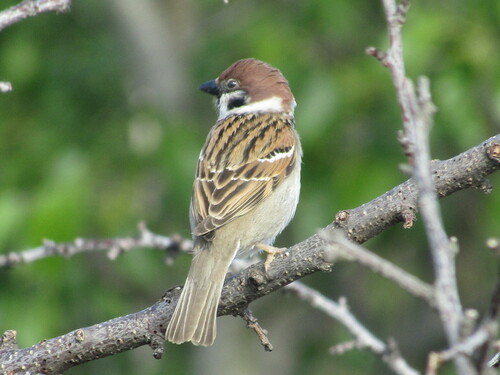
Eurasian Tree Sparrow (Passer montanus) Eurasian Tree Sparrow

Media

Loading…

In short

The most reliable field mark to separate House Sparrow from Eurasian Tree Sparrow is the head pattern: Eurasian Tree Sparrow of all ages and sexes shows a rich chestnut crown and nape with a bold black spot on each pure white cheek, while House Sparrow males have a grey crown and lack the cheek spot, and females/juveniles are plainer. In flight or perched, Eurasian Tree Sparrow is also noticeably smaller and slimmer, with a finer bill and more uniform plumage between sexes. Juvenile confusion is possible, but the face pattern and crown color remain key. House Sparrow males are strongly dimorphic, with bold black bibs and grey crowns, while Eurasian Tree Sparrow shows little sex or age variation.

Identification tips

  1. Face pattern is key: Eurasian Tree Sparrow always shows a rich chestnut crown and nape, pure white cheek with a bold black spot, and a small black throat patch. House Sparrow never shows this combination; males have a grey crown and lack the cheek spot, while females and juveniles are plain-faced.
  2. Crown color: Male House Sparrow has a grey crown with chestnut only on the nape, while Eurasian Tree Sparrow's crown and nape are entirely chestnut. Female and juvenile House Sparrows have no strong crown color.
  3. Cheek and ear coverts: Eurasian Tree Sparrow has a pure white cheek with a black spot (all ages, both sexes). House Sparrow males have white cheeks but no spot; females and juveniles have dull, buffy cheeks with no mark.
  4. Sexual dimorphism: House Sparrow is strongly dimorphic: males are boldly marked with black bibs, grey crowns, and white cheeks; females are plain and brown. Eurasian Tree Sparrow shows little or no sexual dimorphism—males and females look alike.
  5. Size and structure: House Sparrow is noticeably larger and bulkier, with a deeper chest and a thicker, more conical bill. Eurasian Tree Sparrow is smaller, slimmer, and more delicate, with a finer bill. This is most obvious when both species are side by side.
  6. Wing bars: Eurasian Tree Sparrow has two narrow white wing bars on brown wings, visible in all plumages. House Sparrow's wing bars are less distinct, especially in females and juveniles.
  7. Juvenile confusion: Juvenile House Sparrows resemble adult females—plain brown, scruffy, with a weak supercilium and no strong face pattern. Eurasian Tree Sparrow juveniles already show the chestnut crown and cheek spot, though duller than adults.
  8. Bill color: In summer, Eurasian Tree Sparrow has a lead-blue bill, turning nearly black in winter. House Sparrow's bill is generally stouter and varies from pale in juveniles to blackish in breeding males.
  9. Plumage variation: Eurasian Tree Sparrow is consistent across sexes and ages; House Sparrow varies greatly by sex and age, with males much more contrasting than females or juveniles.
  10. Habitat context: In dense urban settings, House Sparrow is far more likely. In rural, farmland, or parkland, especially with old trees or hedgerows, Eurasian Tree Sparrow is more probable.
  11. Behavior: Both species are gregarious, but Eurasian Tree Sparrow is slightly more arboreal and less confiding around people than House Sparrow.
  12. Flight jizz: Eurasian Tree Sparrow appears lighter and more agile in flight, but this is subtle and best used as supporting evidence.
  13. Vocalizations: Not covered in detail in these notes, so use with caution.
  14. Pitfalls: Female and juvenile House Sparrows are the most likely to be confused with Eurasian Tree Sparrow, but always lack the chestnut crown and cheek spot. Male House Sparrow is unlikely to be confused except in poor light or brief views.
  15. Seasonal changes: Eurasian Tree Sparrow's plumage is stable year-round; House Sparrow males are brightest in breeding season, but the key head pattern differences persist.

Size

House Sparrow is distinctly larger and heavier (body mass ~30.5g, length 14–18 cm, wingspan 19–25 cm) than Eurasian Tree Sparrow (body mass ~26g, length 12.5–14 cm, wingspan ~21 cm). In the field, House Sparrow looks bulkier, with a deeper chest and larger, more robust head and bill. Eurasian Tree Sparrow is more petite and compact, with a finer, shorter bill and a generally more delicate appearance. When seen together, the size difference is usually obvious, but beware lone birds or fluffed-up individuals in cold weather.

Plumage

Juvenile and immature birds: Eurasian Tree Sparrow juveniles closely resemble adults, but are duller; their key marks—chestnut crown, white cheek with black spot—are always present, making them separable from House Sparrow at any age. House Sparrow juveniles are similar to adult females: pale brown and grey, lacking any strong face pattern, with a scruffier, looser plumage and paler, less defined supercilium. Some juvenile male House Sparrows may show faint male features, but never the chestnut crown or cheek spot of Eurasian Tree Sparrow.

Adults: Male House Sparrows have a grey crown, chestnut nape, black bib, white cheeks, and a warm brown back with strong black streaks; females are plain buff-brown above and below, lacking strong head markings. Eurasian Tree Sparrow adults of both sexes have a rich chestnut crown and nape, pure white cheek with a bold black spot, and two narrow white wing bars. The sexes are alike in Eurasian Tree Sparrow, while House Sparrow is strongly dimorphic.

In all plumages, Eurasian Tree Sparrow's face pattern is diagnostic, and the brown (not grey) crown is a quick separator from male House Sparrow.

Behaviour

Both species are social and often found in flocks, but House Sparrow is more likely to be seen in very urban settings, feeding on the ground or around human habitation. Eurasian Tree Sparrow is more often found in rural, parkland, or edge habitats, sometimes visiting gardens but less tied to dense urban centers. Both species forage on the ground, but Eurasian Tree Sparrow may be slightly more arboreal, as its name suggests. Flight is direct and bounding in both, but Eurasian Tree Sparrow appears lighter and more agile.

Habitat

House Sparrow is ubiquitous in urban and suburban areas, closely associated with buildings, streets, and human activity. Eurasian Tree Sparrow prefers farmland, hedgerows, woodland edges, parks, and rural villages, and is less common in dense city centers. Where both species occur, House Sparrow dominates the most built-up areas, while Eurasian Tree Sparrow is more likely in less disturbed or semi-natural settings. However, overlap is possible, especially in gardens and parks.

Submit a better description

Use the same sections as the comparison. Your text is published immediately.

The most reliable field mark to separate House Sparrow from Eurasian Tree Sparrow is the head pattern: Eurasian Tree Sparrow of all ages and sexes shows a rich chestnut crown and nape with a bold black spot on each pure white cheek, while House Sparrow males have a grey crown and lack the cheek spot, and females/juveniles are plainer. In flight or perched, Eurasian Tree Sparrow is also noticeably smaller and slimmer, with a finer bill and more uniform plumage between sexes. Juvenile confusion is possible, but the face pattern and crown color remain key. House Sparrow males are strongly dimorphic, with bold black bibs and grey crowns, while Eurasian Tree Sparrow shows little sex or age variation.

  1. Face pattern is key: Eurasian Tree Sparrow always shows a rich chestnut crown and nape, pure white cheek with a bold black spot, and a small black throat patch. House Sparrow never shows this combination; males have a grey crown and lack the cheek spot, while females and juveniles are plain-faced.
  2. Crown color: Male House Sparrow has a grey crown with chestnut only on the nape, while Eurasian Tree Sparrow's crown and nape are entirely chestnut. Female and juvenile House Sparrows have no strong crown color.
  3. Cheek and ear coverts: Eurasian Tree Sparrow has a pure white cheek with a black spot (all ages, both sexes). House Sparrow males have white cheeks but no spot; females and juveniles have dull, buffy cheeks with no mark.
  4. Sexual dimorphism: House Sparrow is strongly dimorphic: males are boldly marked with black bibs, grey crowns, and white cheeks; females are plain and brown. Eurasian Tree Sparrow shows little or no sexual dimorphism—males and females look alike.
  5. Size and structure: House Sparrow is noticeably larger and bulkier, with a deeper chest and a thicker, more conical bill. Eurasian Tree Sparrow is smaller, slimmer, and more delicate, with a finer bill. This is most obvious when both species are side by side.
  6. Wing bars: Eurasian Tree Sparrow has two narrow white wing bars on brown wings, visible in all plumages. House Sparrow's wing bars are less distinct, especially in females and juveniles.
  7. Juvenile confusion: Juvenile House Sparrows resemble adult females—plain brown, scruffy, with a weak supercilium and no strong face pattern. Eurasian Tree Sparrow juveniles already show the chestnut crown and cheek spot, though duller than adults.
  8. Bill color: In summer, Eurasian Tree Sparrow has a lead-blue bill, turning nearly black in winter. House Sparrow's bill is generally stouter and varies from pale in juveniles to blackish in breeding males.
  9. Plumage variation: Eurasian Tree Sparrow is consistent across sexes and ages; House Sparrow varies greatly by sex and age, with males much more contrasting than females or juveniles.
  10. Habitat context: In dense urban settings, House Sparrow is far more likely. In rural, farmland, or parkland, especially with old trees or hedgerows, Eurasian Tree Sparrow is more probable.
  11. Behavior: Both species are gregarious, but Eurasian Tree Sparrow is slightly more arboreal and less confiding around people than House Sparrow.
  12. Flight jizz: Eurasian Tree Sparrow appears lighter and more agile in flight, but this is subtle and best used as supporting evidence.
  13. Vocalizations: Not covered in detail in these notes, so use with caution.
  14. Pitfalls: Female and juvenile House Sparrows are the most likely to be confused with Eurasian Tree Sparrow, but always lack the chestnut crown and cheek spot. Male House Sparrow is unlikely to be confused except in poor light or brief views.
  15. Seasonal changes: Eurasian Tree Sparrow's plumage is stable year-round; House Sparrow males are brightest in breeding season, but the key head pattern differences persist.

House Sparrow is distinctly larger and heavier (body mass ~30.5g, length 14–18 cm, wingspan 19–25 cm) than Eurasian Tree Sparrow (body mass ~26g, length 12.5–14 cm, wingspan ~21 cm). In the field, House Sparrow looks bulkier, with a deeper chest and larger, more robust head and bill. Eurasian Tree Sparrow is more petite and compact, with a finer, shorter bill and a generally more delicate appearance. When seen together, the size difference is usually obvious, but beware lone birds or fluffed-up individuals in cold weather.

Juvenile and immature birds: Eurasian Tree Sparrow juveniles closely resemble adults, but are duller; their key marks—chestnut crown, white cheek with black spot—are always present, making them separable from House Sparrow at any age. House Sparrow juveniles are similar to adult females: pale brown and grey, lacking any strong face pattern, with a scruffier, looser plumage and paler, less defined supercilium. Some juvenile male House Sparrows may show faint male features, but never the chestnut crown or cheek spot of Eurasian Tree Sparrow.

Adults: Male House Sparrows have a grey crown, chestnut nape, black bib, white cheeks, and a warm brown back with strong black streaks; females are plain buff-brown above and below, lacking strong head markings. Eurasian Tree Sparrow adults of both sexes have a rich chestnut crown and nape, pure white cheek with a bold black spot, and two narrow white wing bars. The sexes are alike in Eurasian Tree Sparrow, while House Sparrow is strongly dimorphic.

In all plumages, Eurasian Tree Sparrow's face pattern is diagnostic, and the brown (not grey) crown is a quick separator from male House Sparrow.

Both species are social and often found in flocks, but House Sparrow is more likely to be seen in very urban settings, feeding on the ground or around human habitation. Eurasian Tree Sparrow is more often found in rural, parkland, or edge habitats, sometimes visiting gardens but less tied to dense urban centers. Both species forage on the ground, but Eurasian Tree Sparrow may be slightly more arboreal, as its name suggests. Flight is direct and bounding in both, but Eurasian Tree Sparrow appears lighter and more agile.

House Sparrow is ubiquitous in urban and suburban areas, closely associated with buildings, streets, and human activity. Eurasian Tree Sparrow prefers farmland, hedgerows, woodland edges, parks, and rural villages, and is less common in dense city centers. Where both species occur, House Sparrow dominates the most built-up areas, while Eurasian Tree Sparrow is more likely in less disturbed or semi-natural settings. However, overlap is possible, especially in gardens and parks.

Discard your changes?

You have unsaved edits. If you leave now, those changes will be lost.

House Sparrow · Eurasian Tree Sparrow · My Tricky Birds