Birdr

House Swift vs Siberian House Martin

Apus nipalensis versus Delichon lagopodum

Play a quiz with House Swift and Siberian House Martin
House Swift (Apus nipalensis) House Swift
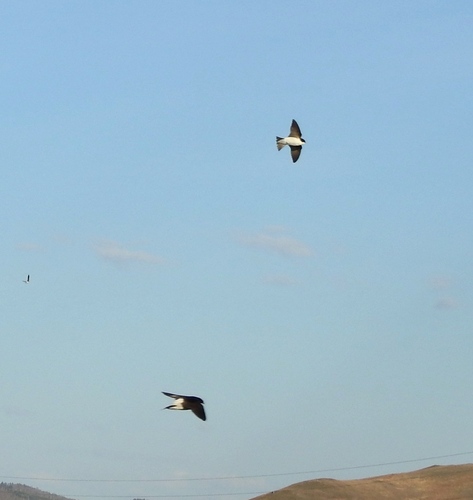
Siberian House Martin (Delichon lagopodum) Siberian House Martin

Media

Loading…

In short

The House Swift and Siberian House Martin can be distinguished primarily by their structure and plumage. The House Swift has a more streamlined body with longer, sickle-shaped wings and lacks the white rump patch seen in the Siberian House Martin. Observing these features in flight can help differentiate the two species.

Identification tips

1. Look for the white rump patch: Present in Siberian House Martin, absent in House Swift. 2. Observe wing shape: House Swift has longer, sickle-shaped wings. 3. Check flight style: House Swift tends to fly higher and faster. 4. Consider habitat: House Swift is more urban, while Siberian House Martin is often near water. 5. Listen for calls: House Swift's calls are more rapid and twittering.

Size

House Swift is generally more slender with longer wings, while Siberian House Martin is stockier with a shorter tail.

Plumage

House Swift is uniformly dark with no white rump, whereas Siberian House Martin has a distinctive white rump and underparts, contrasting with its dark upperparts.

Behaviour

Both species are aerial insectivores, but House Swifts are often seen flying higher and more rapidly, while Siberian House Martins may be observed closer to structures or water bodies.

Habitat

House Swifts are typically found near urban areas and cliffs, whereas Siberian House Martins prefer open areas near water and human settlements.

Voice

Vocalizations are not the most reliable differentiator in the field, as both species have high-pitched calls, but House Swift's calls are generally more rapid and twittering.

Submit a better description

Use the same sections as the comparison. Your text is published immediately.

The House Swift and Siberian House Martin can be distinguished primarily by their structure and plumage. The House Swift has a more streamlined body with longer, sickle-shaped wings and lacks the white rump patch seen in the Siberian House Martin. Observing these features in flight can help differentiate the two species.

1. Look for the white rump patch: Present in Siberian House Martin, absent in House Swift. 2. Observe wing shape: House Swift has longer, sickle-shaped wings. 3. Check flight style: House Swift tends to fly higher and faster. 4. Consider habitat: House Swift is more urban, while Siberian House Martin is often near water. 5. Listen for calls: House Swift's calls are more rapid and twittering.

House Swift is generally more slender with longer wings, while Siberian House Martin is stockier with a shorter tail.

House Swift is uniformly dark with no white rump, whereas Siberian House Martin has a distinctive white rump and underparts, contrasting with its dark upperparts.

Both species are aerial insectivores, but House Swifts are often seen flying higher and more rapidly, while Siberian House Martins may be observed closer to structures or water bodies.

House Swifts are typically found near urban areas and cliffs, whereas Siberian House Martins prefer open areas near water and human settlements.

Vocalizations are not the most reliable differentiator in the field, as both species have high-pitched calls, but House Swift's calls are generally more rapid and twittering.

Discard your changes?

You have unsaved edits. If you leave now, those changes will be lost.

House Swift · Siberian House Martin · My Tricky Birds