Birdr

Indigo Bunting vs Painted Bunting

Passerina cyanea versus Passerina ciris

Play a quiz with Indigo Bunting and Painted Bunting
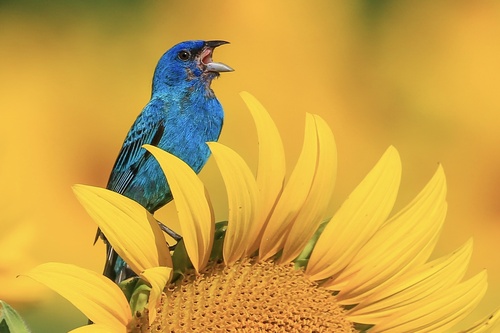
Indigo Bunting (Passerina cyanea) Indigo Bunting
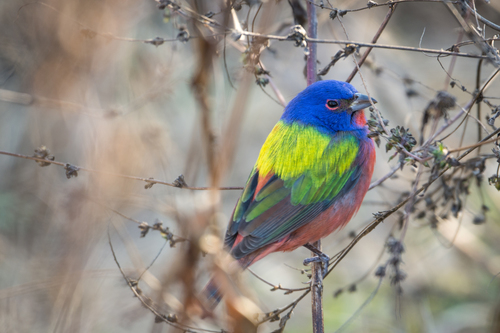
Painted Bunting (Passerina ciris) Painted Bunting

Media

Loading…

In short

Indigo Buntings and Painted Buntings are both small, colorful songbirds, but they can be distinguished by their plumage and habitat preferences. Male Indigo Buntings are uniformly blue, while male Painted Buntings have a striking combination of blue, green, and red. Females and juveniles of both species are more similar, being mostly brown, but the Painted Bunting's females are more uniformly greenish-brown.

Identification tips

Size

Both species are similar in size, with no significant differences in measurements that are easily observable in the field.

Plumage

Male Indigo Buntings are all blue, while male Painted Buntings have a vibrant mix of blue heads, green backs, and red underparts. Female Indigo Buntings are light brown with buff wing bars, whereas female Painted Buntings are more uniformly greenish-brown without wing bars.

Behaviour

Both species exhibit similar behaviors typical of small passerines, such as foraging for seeds and insects. No significant behavioral differences are noted for field identification.

Habitat

Indigo Buntings are often found in open woodlands, edges, and brushy areas, while Painted Buntings prefer more dense, shrubby habitats, particularly in the southeastern U.S. during breeding season.

Voice

Both species have distinctive songs, but they are not typically used for field identification unless the observer is familiar with their specific calls.

Submit a better description

Use the same sections as the comparison. Your text is published immediately.

Indigo Buntings and Painted Buntings are both small, colorful songbirds, but they can be distinguished by their plumage and habitat preferences. Male Indigo Buntings are uniformly blue, while male Painted Buntings have a striking combination of blue, green, and red. Females and juveniles of both species are more similar, being mostly brown, but the Painted Bunting's females are more uniformly greenish-brown.

  • Male Plumage: Look for the all-blue plumage of male Indigo Buntings versus the multicolored plumage of male Painted Buntings.
  • Female Plumage: Note the more uniform greenish-brown of female Painted Buntings compared to the light brown with buff wing bars of female Indigo Buntings.
  • Habitat: Consider the habitat; Painted Buntings prefer denser shrubbery, while Indigo Buntings are more often in open areas.
  • Seasonal Variation: Be aware that first-year male Indigo Buntings can show mixed plumage, which may cause confusion.

Both species are similar in size, with no significant differences in measurements that are easily observable in the field.

Male Indigo Buntings are all blue, while male Painted Buntings have a vibrant mix of blue heads, green backs, and red underparts. Female Indigo Buntings are light brown with buff wing bars, whereas female Painted Buntings are more uniformly greenish-brown without wing bars.

Both species exhibit similar behaviors typical of small passerines, such as foraging for seeds and insects. No significant behavioral differences are noted for field identification.

Indigo Buntings are often found in open woodlands, edges, and brushy areas, while Painted Buntings prefer more dense, shrubby habitats, particularly in the southeastern U.S. during breeding season.

Both species have distinctive songs, but they are not typically used for field identification unless the observer is familiar with their specific calls.

Discard your changes?

You have unsaved edits. If you leave now, those changes will be lost.

Indigo Bunting · Painted Bunting · My Tricky Birds