
Isabelline Wheatear vs Western Black-eared Wheatear
Oenanthe isabellina versus Oenanthe hispanica
Play a quiz with Isabelline Wheatear and Western Black-eared Wheatear
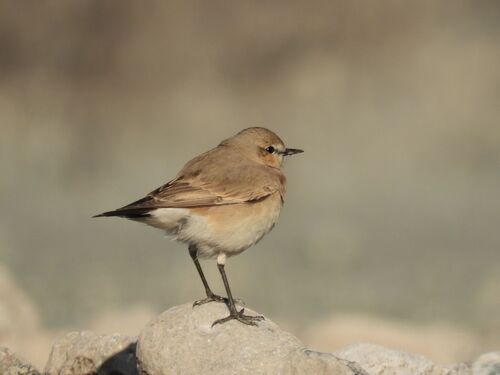
Isabelline Wheatear
Western Black-eared Wheatear
In short
The Isabelline Wheatear and Western Black-eared Wheatear can be distinguished by their plumage and structural differences. The Isabelline Wheatear typically has a more uniform sandy-buff coloration with a weak pale supercilium, while the Western Black-eared Wheatear shows stronger contrast with a distinct black ear patch in males. Both species inhabit open areas, but their behavior and vocalizations can also aid in identification.
Identification tips
1. Look for the black ear patch in male Western Black-eared Wheatears, absent in Isabelline Wheatears. 2. Note the overall sandy-buff coloration of the Isabelline Wheatear. 3. Observe behavior: Isabelline Wheatears often have a more upright posture. 4. Consider habitat: Isabelline Wheatears may prefer more barren landscapes. 5. Listen for vocalizations, although these are less reliable for differentiation.
Size
Both species are similar in size, typical of wheatears, with no significant difference in overall body length.
Plumage
The Isabelline Wheatear has a sandy-buff overall coloration, with black lores and a broad black terminal tail band. It has a weak pale supercilium. In contrast, the Western Black-eared Wheatear male has a striking black ear patch and a more contrasting plumage, with a white or buffy throat and underparts.
Behaviour
Isabelline Wheatears are known for their upright stance and frequent tail flicking. Western Black-eared Wheatears also exhibit tail flicking but may be more active in their movements.
Habitat
Both species favor open, dry habitats such as steppes and semi-deserts. However, the Isabelline Wheatear is more likely to be found in slightly more barren areas compared to the Western Black-eared Wheatear.
Voice
The vocalizations of these species are not distinctly different in the field, with both producing typical wheatear calls. However, the Western Black-eared Wheatear may have a slightly more varied song.
Isabelline Wheatear · Western Black-eared Wheatear · My Tricky Birds