
Japanese Thrush vs Grey-backed Thrush
Turdus cardis versus Turdus hortulorum
Play a quiz with Japanese Thrush and Grey-backed Thrush
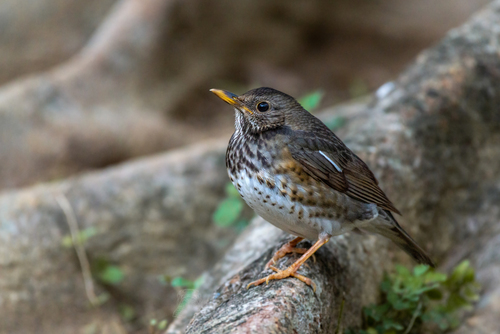 Japanese Thrush
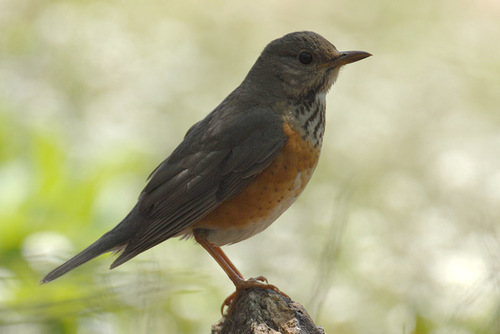 Grey-backed Thrush
In short
The most reliable way to separate Japanese Thrush from Grey-backed Thrush is by focusing on the male plumage: male Japanese Thrushes have a striking black head, back, and breast, while male Grey-backed Thrushes are slate-grey above and on the breast, never truly black. Females of both species are more similar, but Japanese Thrush females are browner above and show a rusty wash on the flanks, while Grey-backed Thrush females are greyer or browner above with rufous-orange flanks. Both species are sexually dimorphic and medium-sized, but the combination of head and upperpart color, along with flank coloration and spotting, are the best field clues. There are no distinctive wing or flight patterns described for immatures, so focus on perched views and overall color contrasts.
Identification tips
- Male head and upperparts color: Male Japanese Thrushes have a deep black head, back, and breast, while male Grey-backed Thrushes are slate-grey above and on the breast. This is the most reliable mark in adult males.
- Female upperparts: Female Japanese Thrushes are brown above, while female Grey-backed Thrushes are greyer or browner, often with a colder tone. Use this mark with caution, as lighting can affect perceived color.
- Flank color: Both species show rufous or rusty flanks, but in Japanese Thrush the rusty wash is more limited and overlaying a white belly, while in Grey-backed Thrush the rufous-orange is more extensive and set against a paler (not pure white) belly.
- Underpart spotting: Japanese Thrushes of both sexes show blackish spots on the upper belly and flanks (males) or breast and flanks (females). Grey-backed Thrushes have dark spotting on the breast (females), but the pattern is less bold and the background is paler.
- Throat and belly: Japanese Thrushes have a clean white throat and belly, especially in males. Grey-backed Thrushes have a whitish chin and belly, but the contrast is less stark.
- Bill and leg color: Japanese Thrushes have yellow legs, bill, and a thin yellow eye-ring, which can be a helpful supporting mark in good light. Grey-backed Thrushes may have duller bare parts (not emphasized in sources).
- Sexual dimorphism: Both species are sexually dimorphic, so always consider sex when comparing plumage. Female Grey-backed Thrushes can be especially similar to female Japanese Thrushes; focus on upperpart tone and underpart contrast.
- No distinctive wing/flight pattern: There are no described age-specific upperwing or flight marks for either species, so do not rely on flight views for separation.
- Size and structure: Both are medium-sized Turdus thrushes with similar proportions. Size and jizz are not reliable for separation.
- Habitat and range: If you are birding outside Japan or in the Russian Far East, Grey-backed Thrush is more likely; in Japan, Japanese Thrush is expected. However, both can occur as migrants or winterers in China, so always check plumage first.
- Juvenile/immature birds: No distinctive juvenile or immature marks are described for either species, so use adult-like features as they develop.
- Lighting pitfalls: Overcast or shadowed conditions can make black appear grey or brown appear greyish, so always try to get multiple views.
- Perched vs. in flight: Since there are no flight-specific marks, prioritize perched views for identification.
- Spotting and flank color together: The combination of bold black spotting and rusty flanks on a white belly (Japanese Thrush) vs. less bold spotting and more extensive rufous-orange flanks on a paler belly (Grey-backed Thrush) is a useful two-feature check.
- Consult local abundance: In some regions, one species may be much more common than the other, which can help narrow down tricky individuals, but always confirm with plumage.
Size
Both species are medium-sized thrushes and very similar in overall structure and mass. The Grey-backed Thrush averages about 65 g in body mass, which is typical for a Turdus thrush; no mass is given for Japanese Thrush, but it is described as mid-sized and comparable. Lengths are nearly identical (Grey-backed Thrush: 20–23 cm). In the field, size alone is not a reliable separator between these two.
Plumage
There are no age-specific wing or flight pattern differences described for either species, so focus on body plumage.
- Adult males: Japanese Thrush males are black on the head, back, breast, wings, and tail, with a white underside and black spotting on the upper belly and flanks. Grey-backed Thrush males have slate-grey upperparts and breast (never truly black), a whitish chin and belly, and rufous-orange flanks.
- Adult females: Japanese Thrush females are brown above, with a white throat, breast, and belly, rusty orange wash on the flanks, and black spots. Grey-backed Thrush females are greyer or browner above, with dark spotting on the breast and rufous-orange flanks (the rufous is similar in both, but the background color is greyer in Grey-backed Thrush).
- Both sexes: Both species show some spotting on the underparts, but the pattern and background color differ. The Japanese Thrush tends to have a more contrasting, clean white belly and throat, while Grey-backed Thrush is paler but less starkly white.
- Bare parts: Japanese Thrushes have yellow legs, bill, and a thin yellow eye-ring; these features are less emphasized for Grey-backed Thrush.
Behaviour
No behavioral differences are described between these two species in the sources. Both are typical Turdus thrushes, likely to forage on the ground or in low vegetation and to perch upright. Behavior is not a reliable separator.
Habitat
Both species inhabit wooded or forested habitats, but their breeding and wintering ranges differ. Japanese Thrush is mostly associated with Japan and parts of China, while Grey-backed Thrush breeds in northeastern China, the Russian Far East, and North Korea, wintering in southern China and northern Vietnam. In areas of overlap (e.g., migration or winter), habitat alone will not separate them, but context may help if you know the local status.