Birdr

Japanese Woodpigeon vs Asian Emerald Dove

Columba janthina versus Chalcophaps indica

Play a quiz with Japanese Woodpigeon and Asian Emerald Dove
Japanese Woodpigeon (Columba janthina) Japanese Woodpigeon
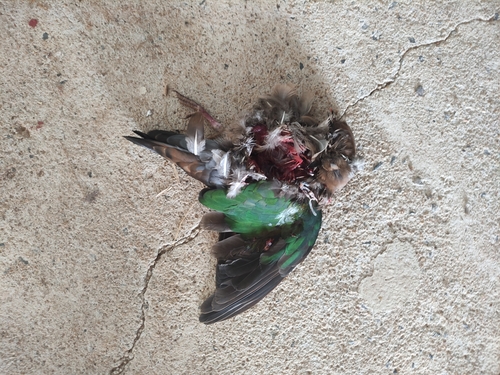
Asian Emerald Dove (Chalcophaps indica) Asian Emerald Dove

Media

Loading…

In short

The Japanese Woodpigeon and the Asian Emerald Dove are both medium-sized pigeons, but they differ notably in plumage and habitat preferences. The Japanese Woodpigeon is predominantly dark with a metallic sheen, while the Asian Emerald Dove is smaller and more colorful, with striking green wings. Both species can be found in forested areas, but the Emerald Dove is more adaptable to secondary growth.

Identification tips

  1. Look for the metallic sheen on the neck of the Japanese Woodpigeon. 2. Note the bright green wings of the Asian Emerald Dove. 3. Consider habitat: Japanese Woodpigeons prefer mature forests, while Asian Emerald Doves are often at forest edges. 4. Listen for the soft cooing of the Asian Emerald Dove.

Size

The Japanese Woodpigeon is generally larger and bulkier than the Asian Emerald Dove.

Plumage

The Japanese Woodpigeon has a dark plumage with a metallic sheen, especially on the neck, whereas the Asian Emerald Dove is characterized by its bright green wings and a more colorful appearance overall.

Behaviour

Both species are typically shy and prefer dense forest cover, but the Asian Emerald Dove is more likely to be seen at forest edges and in secondary growth.

Habitat

The Japanese Woodpigeon is more restricted to mature forests, while the Asian Emerald Dove is found in a wider range of habitats, including secondary forests and forest edges.

Voice

Vocalizations are not well-documented for the Japanese Woodpigeon, while the Asian Emerald Dove has a distinctive, soft cooing sound.

Submit a better description

Use the same sections as the comparison. Your text is published immediately.

The Japanese Woodpigeon and the Asian Emerald Dove are both medium-sized pigeons, but they differ notably in plumage and habitat preferences. The Japanese Woodpigeon is predominantly dark with a metallic sheen, while the Asian Emerald Dove is smaller and more colorful, with striking green wings. Both species can be found in forested areas, but the Emerald Dove is more adaptable to secondary growth.

  1. Look for the metallic sheen on the neck of the Japanese Woodpigeon. 2. Note the bright green wings of the Asian Emerald Dove. 3. Consider habitat: Japanese Woodpigeons prefer mature forests, while Asian Emerald Doves are often at forest edges. 4. Listen for the soft cooing of the Asian Emerald Dove.

The Japanese Woodpigeon is generally larger and bulkier than the Asian Emerald Dove.

The Japanese Woodpigeon has a dark plumage with a metallic sheen, especially on the neck, whereas the Asian Emerald Dove is characterized by its bright green wings and a more colorful appearance overall.

Both species are typically shy and prefer dense forest cover, but the Asian Emerald Dove is more likely to be seen at forest edges and in secondary growth.

The Japanese Woodpigeon is more restricted to mature forests, while the Asian Emerald Dove is found in a wider range of habitats, including secondary forests and forest edges.

Vocalizations are not well-documented for the Japanese Woodpigeon, while the Asian Emerald Dove has a distinctive, soft cooing sound.

Discard your changes?

You have unsaved edits. If you leave now, those changes will be lost.

Japanese Woodpigeon · Asian Emerald Dove · My Tricky Birds