Birdr

Jelski's Chat-Tyrant vs Yellow-bellied Chat-Tyrant

Silvicultrix jelskii versus Silvicultrix diadema

Play a quiz with Jelski's Chat-Tyrant and Yellow-bellied Chat-Tyrant
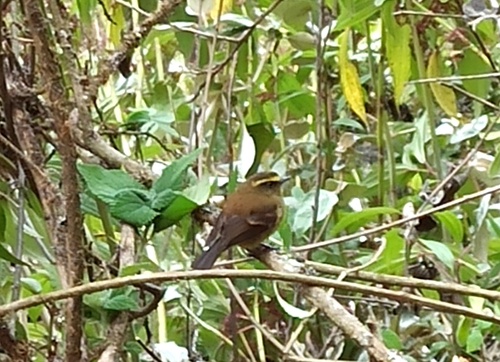
Jelski's Chat-Tyrant (Silvicultrix jelskii) Jelski's Chat-Tyrant
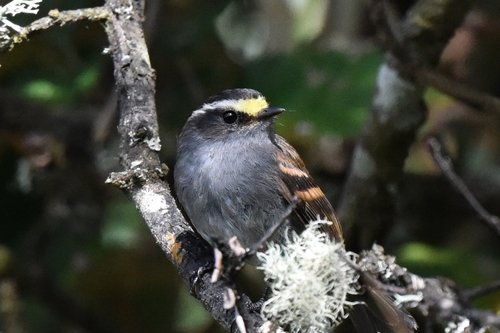
Yellow-bellied Chat-Tyrant (Silvicultrix diadema) Yellow-bellied Chat-Tyrant

Media

Loading…

In short

Jelski's Chat-Tyrant is distinguished by its broad rusty wingbars on blackish wings, while the Yellow-bellied Chat-Tyrant lacks such prominent wingbars. Both species have a white supercilium, but Jelski's also shows a yellow supraloral. Vocalizations can aid identification, as the Yellow-bellied Chat-Tyrant is sometimes detected by its tight, descending trill.

Identification tips

  1. Look for broad rusty wingbars on Jelski's Chat-Tyrant. 2. Note the yellow belly of the Yellow-bellied Chat-Tyrant. 3. Listen for the descending trill of the Yellow-bellied Chat-Tyrant. 4. Check for the yellow supraloral on Jelski's Chat-Tyrant. 5. Consider habitat and elevation, as Jelski's is found between 2600 and 3400 meters.

Size

Both species are similar in size, typical of small tyrant flycatchers.

Plumage

Jelski's Chat-Tyrant is medium brown above and gray below with broad rusty wingbars, a white supercilium, and a yellow supraloral. The Yellow-bellied Chat-Tyrant lacks the rusty wingbars and has a yellow belly, which is a key difference.

Behaviour

Jelski's Chat-Tyrant is rather inconspicuous, foraging low in the undergrowth, while the Yellow-bellied Chat-Tyrant may be more detectable due to its vocalizations.

Habitat

Jelski's Chat-Tyrant is found at elevations from 2600 to 3400 meters. The habitat preferences of the Yellow-bellied Chat-Tyrant are not detailed here, but both species are likely to overlap in montane forests.

Voice

Jelski's Chat-Tyrant is thought to be rather silent, whereas the Yellow-bellied Chat-Tyrant can be detected by its song, a tight, descending trill.

Submit a better description

Use the same sections as the comparison. Your text is published immediately.

Jelski's Chat-Tyrant is distinguished by its broad rusty wingbars on blackish wings, while the Yellow-bellied Chat-Tyrant lacks such prominent wingbars. Both species have a white supercilium, but Jelski's also shows a yellow supraloral. Vocalizations can aid identification, as the Yellow-bellied Chat-Tyrant is sometimes detected by its tight, descending trill.

  1. Look for broad rusty wingbars on Jelski's Chat-Tyrant. 2. Note the yellow belly of the Yellow-bellied Chat-Tyrant. 3. Listen for the descending trill of the Yellow-bellied Chat-Tyrant. 4. Check for the yellow supraloral on Jelski's Chat-Tyrant. 5. Consider habitat and elevation, as Jelski's is found between 2600 and 3400 meters.

Both species are similar in size, typical of small tyrant flycatchers.

Jelski's Chat-Tyrant is medium brown above and gray below with broad rusty wingbars, a white supercilium, and a yellow supraloral. The Yellow-bellied Chat-Tyrant lacks the rusty wingbars and has a yellow belly, which is a key difference.

Jelski's Chat-Tyrant is rather inconspicuous, foraging low in the undergrowth, while the Yellow-bellied Chat-Tyrant may be more detectable due to its vocalizations.

Jelski's Chat-Tyrant is found at elevations from 2600 to 3400 meters. The habitat preferences of the Yellow-bellied Chat-Tyrant are not detailed here, but both species are likely to overlap in montane forests.

Jelski's Chat-Tyrant is thought to be rather silent, whereas the Yellow-bellied Chat-Tyrant can be detected by its song, a tight, descending trill.

Discard your changes?

You have unsaved edits. If you leave now, those changes will be lost.

Jelski's Chat-Tyrant · Yellow-bellied Chat-Tyrant · My Tricky Birds