
Jungle Myna vs Great Myna
Acridotheres fuscus versus Acridotheres grandis
Play a quiz with Jungle Myna and Great Myna
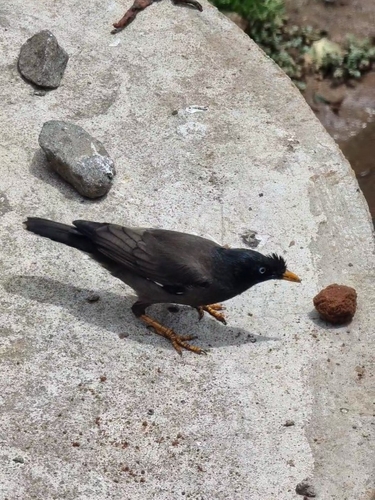 Jungle Myna
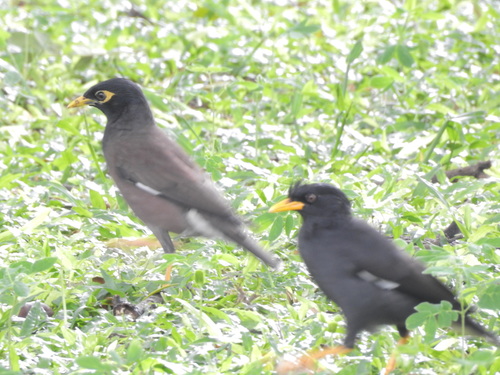 Great Myna
In short
The most reliable field mark to separate Jungle Myna from Great Myna is the extent and pattern of white on the vent and tail: Great Myna shows a bold white area from the vent all the way to the tip of the tail, while Jungle Myna has only a pale creamy or smoky vent and broad white tips to the tail feathers. In flight, both species show a white wing patch, but the Great Myna's white is more extensive and the bird appears overall darker and glossier. Both have a frontal crest, but the Great Myna's is longer and often curls back more noticeably. Juvenile Jungle Mynas are browner with a pale throat, while Great Myna juveniles are not described in detail but are likely darker overall. Use iris color and vent pattern for local populations when possible, but beware of overlap and variation.
Identification tips
- Vent and tail pattern (all ages): Great Myna shows a bold white area from the vent to the tip of the tail, forming a continuous white patch when viewed from behind or below. Jungle Myna has only a pale creamy or smoky vent (depending on population), with broad white tips to the tail feathers but not a solid white vent-to-tail panel.
- Wing patch in flight (all ages): Both species show a white wing patch at the base of the primaries, but Great Myna's is typically more extensive and the bird appears overall blacker and glossier in flight, while Jungle Myna is greyer with less contrast.
- Frontal crest (adults): Both have a tufted crest, but Great Myna's is longer and often curls back more noticeably. Jungle Myna's crest is shorter and more upright.
- Overall color (adults): Jungle Myna is grey with a darker head and wings; Great Myna is blacker and glossier overall.
- Bill color (adults): Both have yellow bills, but Jungle Myna often shows a darker base with a bluish tinge, especially on the lower mandible. Great Myna's bill is plain yellow.
- Iris color (adults, regional): Some Jungle Myna populations (southern India) have a blue iris, others (northeast India, Burma, Malay Peninsula) have a yellow iris. Great Myna's iris color is not described, so use this mark with caution.
- Juvenile plumage: Juvenile Jungle Mynas are browner with a pale throat and paler underside; Great Myna juveniles are likely darker and glossier, but details are lacking.
- Bare skin around eye: Neither species shows bare skin around the eye (unlike Common or Bank Myna), so this is not a separator between the two.
- Habitat (contextual): In overlapping areas, Jungle Myna is more likely in open, agricultural, or urban settings, while Great Myna may prefer wetter or more forested habitats, but this is not diagnostic.
- Behavior: Both species forage on the ground and may be seen in mixed flocks, but Jungle Myna is more often seen perching on livestock or following ploughs.
- Voice: Calls are not reliably separable in the field based on current information.
- Sex and season: Both species are sexually monomorphic and do not show strong seasonal plumage changes, so these are not useful for separation.
- Pitfalls: Beware of variation within Jungle Myna populations (vent color, iris color) and possible overlap with Great Myna in Northeast India. Always prioritize the vent-to-tail white pattern and overall glossiness for field separation.
- Leucism: Abnormal pale or leucistic Jungle Mynas have been recorded and may confuse the issue; check for structural and pattern marks before relying on overall color.
- Mixed flocks: Both species may occur together, especially in Northeast India. Careful observation of vent/tail pattern and crest length is essential when birds are seen together.
Size
Jungle Myna has a recorded average body mass of 83 g [wikidata], but no measurement is available for Great Myna. Both are similar in size and structure, with Jungle Myna about 23 cm in length. In the field, size is not a reliable separator between these two, as both are robust, medium-sized mynas with similar proportions.
Plumage
- Juvenile/immature birds: Jungle Myna juveniles are browner overall, with a pale throat and paler underside, while Great Myna immatures are not described in detail but are likely darker and glossier, matching adult pattern more closely.
- Adults: Both species are dark with a prominent white wing patch visible in flight. Jungle Myna is grey overall with a darker head and wings, and has a pale creamy or smoky vent (depending on population), with broad white tips to the tail feathers. Great Myna is blacker and glossier, with a striking white area from the vent to the tip of the tail, creating a much more extensive white patch when seen from behind or below. Both have a frontal crest, but Great Myna's is longer and often curls back. Both have yellow bills and legs, but Jungle Myna's bill base is darker with a bluish tinge in adults. Iris color varies in Jungle Myna (yellow or blue depending on region), but is not described for Great Myna.
Behaviour
Both species are omnivorous and forage mainly on the ground, often in flocks and sometimes with other mynas. Jungle Myna is known to perch on grazing mammals and follow ploughs, and is often seen in more urban or agricultural settings. Great Myna's behavior is not described in detail, but as a close relative, it is likely similar. Both species use secondary cavities for nesting and are opportunistic in their feeding habits.
Habitat
Jungle Myna is patchily distributed across much of the Indian Subcontinent, but avoids arid zones. Great Myna is found from Sikkim across Northeast India and into Indochina. Where their ranges overlap (Northeast India), both may be found in similar habitats, but Jungle Myna is more likely in open country, agricultural land, and urban edges, while Great Myna may prefer wetter or more forested areas. Habitat is not a strong separator where both occur.
Voice
Jungle Myna has higher-pitched calls than Common Myna, with clipped cheeping contact calls. No specific vocal description is available for Great Myna, but as a close relative, its calls are likely similar. Voice is not a reliable separator between these two species based on available information.