Birdr

Karoo Bustard vs Black Bustard

Heterotetrax vigorsii versus Afrotis afra

Play a quiz with Karoo Bustard and Black Bustard
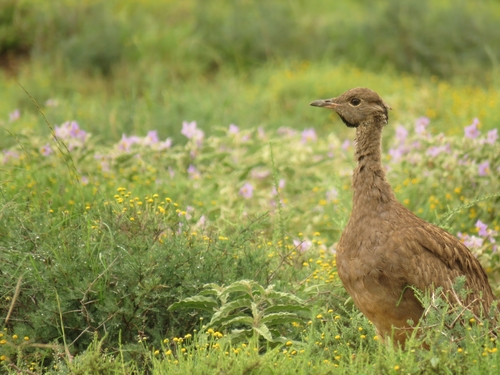
Karoo Bustard (Heterotetrax vigorsii) Karoo Bustard
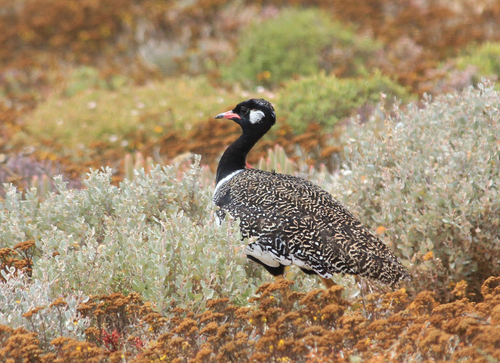
Black Bustard (Afrotis afra) Black Bustard

Media

Loading…

In short

The Karoo Bustard and Black Bustard are both medium-sized bustards found in southern Africa, but they can be distinguished by plumage and habitat preferences. The Karoo Bustard has a distinctive black patch from chin to foreneck, while the Black Bustard male has a largely black head and underparts with a white cheek patch and collar.

Identification tips

1. Look for the black patch from chin to foreneck on the Karoo Bustard. 2. Note the black head and underparts with a white cheek patch and collar on the male Black Bustard. 3. Observe habitat: Karoo Bustards in dry, open areas; Black Bustards in fynbos biome. 4. Consider behavior: Black Bustard males perform aerial displays.

Size

Both species are similar in size, typical of medium-sized bustards.

Plumage

The Karoo Bustard features a black patch from chin to foreneck, off-white belly, and pinkish upperparts. The Black Bustard male has a black head and underparts with a white cheek patch and collar, while the female lacks the cheek patch and collar, with black confined to the belly and posterior underparts.

Behaviour

Karoo Bustards are typically found in pairs or small parties and may be cooperative breeders. Black Bustards are conspicuous during male aerial displays.

Habitat

Karoo Bustards inhabit dry, open karoo country with scattered shrubs and stony substrate. Black Bustards prefer renosterveld and strandveld in the fynbos biome and may occupy cultivated areas with remnant natural vegetation.

Voice

Both species are vocal year-round, but specific vocal differences are not detailed in the sources.

Submit a better description

Use the same sections as the comparison. Your text is published immediately.

The Karoo Bustard and Black Bustard are both medium-sized bustards found in southern Africa, but they can be distinguished by plumage and habitat preferences. The Karoo Bustard has a distinctive black patch from chin to foreneck, while the Black Bustard male has a largely black head and underparts with a white cheek patch and collar.

1. Look for the black patch from chin to foreneck on the Karoo Bustard. 2. Note the black head and underparts with a white cheek patch and collar on the male Black Bustard. 3. Observe habitat: Karoo Bustards in dry, open areas; Black Bustards in fynbos biome. 4. Consider behavior: Black Bustard males perform aerial displays.

Both species are similar in size, typical of medium-sized bustards.

The Karoo Bustard features a black patch from chin to foreneck, off-white belly, and pinkish upperparts. The Black Bustard male has a black head and underparts with a white cheek patch and collar, while the female lacks the cheek patch and collar, with black confined to the belly and posterior underparts.

Karoo Bustards are typically found in pairs or small parties and may be cooperative breeders. Black Bustards are conspicuous during male aerial displays.

Karoo Bustards inhabit dry, open karoo country with scattered shrubs and stony substrate. Black Bustards prefer renosterveld and strandveld in the fynbos biome and may occupy cultivated areas with remnant natural vegetation.

Both species are vocal year-round, but specific vocal differences are not detailed in the sources.

Discard your changes?

You have unsaved edits. If you leave now, those changes will be lost.

Karoo Bustard · Black Bustard · My Tricky Birds