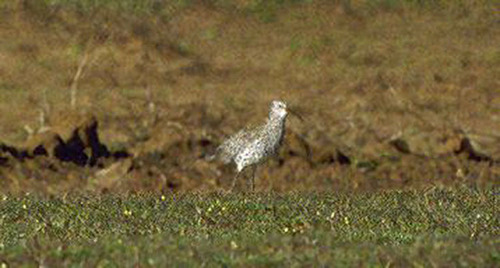
Kentish Plover vs Slender-billed Curlew
Anarhynchus alexandrinus versus Numenius tenuirostris
Play a quiz with Kentish Plover and Slender-billed Curlew

Kentish Plover
Slender-billed Curlew
In short
The Kentish Plover and Slender-billed Curlew are distinct in size and structure, with the former being a small plover and the latter a larger curlew. The Kentish Plover is notable for its white collar and black facial markings, while the Slender-billed Curlew is pale with a slim, pointed bill and distinctive dark flank markings. Vocalizations differ, with the curlew having a unique 'cour-lee' call.
Identification tips
- Size and Structure: Note the significant size difference; the Slender-billed Curlew is much larger with a longer, slender bill. 2. Plumage: Look for the Kentish Plover's white collar and black facial patches. The Slender-billed Curlew is pale with distinctive heart-shaped dark markings on the flanks. 3. Habitat: Kentish Plovers are more likely on sandy shores, while Slender-billed Curlews prefer wetlands. 4. Vocalization: Listen for the Slender-billed Curlew's unique 'cour-lee' call, which is higher-pitched than other curlews.
Size
The Kentish Plover is much smaller, measuring 15–17.5 cm in length, compared to the Slender-billed Curlew's 36–41 cm.
Plumage
The Kentish Plover has a white collar and variable rufous cap with black patches, while the Slender-billed Curlew is very pale with heart-shaped dark markings on the breast and flanks.
Behaviour
Both species feed on invertebrates, but the Kentish Plover often forages on mudflats and beaches, whereas the Slender-billed Curlew is known to probe in soft mud and soil.
Habitat
Kentish Plovers are found on sandy and muddy shores, while Slender-billed Curlews are associated with wetlands and lagoons.
Voice
The Slender-billed Curlew's call is a 'cour-lee' similar to other curlews but higher-pitched and sometimes followed by a laughing trill. The Kentish Plover's calls are not detailed here.