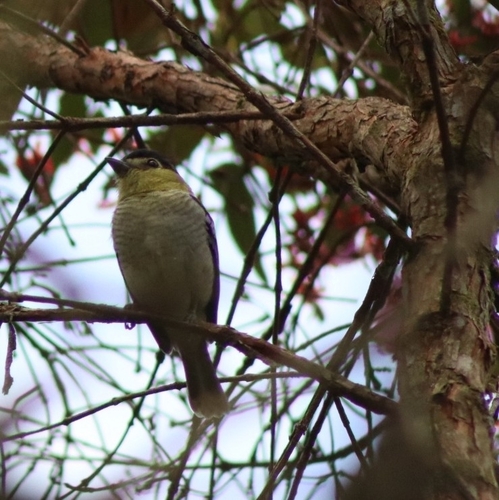
Lanceolated Monklet vs Barred Becard
Micromonacha lanceolata versus Pachyramphus versicolor
Play a quiz with Lanceolated Monklet and Barred Becard
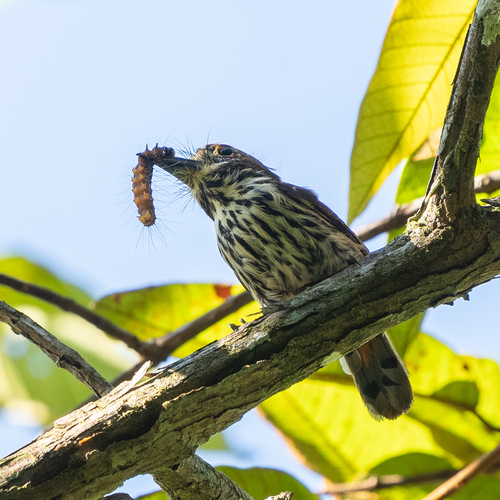
Lanceolated Monklet
Barred Becard
In short
The Lanceolated Monklet and Barred Becard can be distinguished primarily by their size and plumage patterns. The monklet is smaller with a more compact build, while the becard is larger and more robust. Plumage differences are notable, with the monklet having a more uniform brown appearance compared to the becard's distinctive barring.
Identification tips
- Size and Shape: Note the smaller, more compact size of the monklet. 2. Plumage Patterns: Look for the monklet's uniform brown plumage versus the becard's barred underparts. 3. Behavior: Observe the monklet's tendency to remain still, compared to the more active becard. 4. Habitat: Consider the habitat, as monklets prefer denser forests. 5. Vocalization: Listen for the monklet's soft calls versus the becard's clear whistles.
Size
The Lanceolated Monklet is smaller and more compact than the Barred Becard, which is larger and more robust.
Plumage
The Lanceolated Monklet has a mostly uniform brown plumage with subtle streaking, whereas the Barred Becard features distinct barring on the underparts and a more contrasting plumage overall.
Behaviour
The Lanceolated Monklet tends to perch quietly and unobtrusively, often remaining still for long periods, while the Barred Becard is more active and may be seen foraging in mixed-species flocks.
Habitat
Both species inhabit forested areas, but the Lanceolated Monklet is more often found in dense, humid forests, while the Barred Becard can be found in a wider range of forest types, including more open areas.
Voice
The vocalizations of these species differ, with the Lanceolated Monklet having a soft, high-pitched call, while the Barred Becard produces a series of clear, whistled notes. Specific vocal details are not well-documented for both species.