Birdr

Lanceolated Monklet vs White-fronted Nunbird

Micromonacha lanceolata versus Monasa morphoeus

Play a quiz with Lanceolated Monklet and White-fronted Nunbird
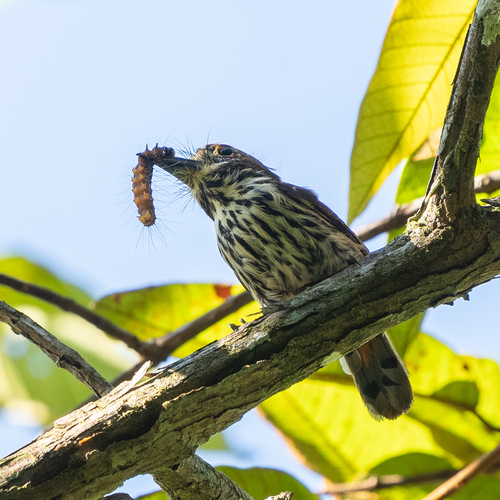
Lanceolated Monklet (Micromonacha lanceolata) Lanceolated Monklet
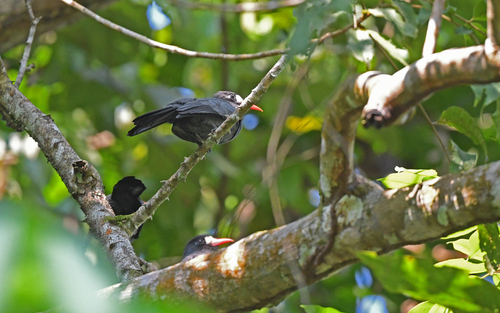
White-fronted Nunbird (Monasa morphoeus) White-fronted Nunbird

Media

Loading…

In short

The Lanceolated Monklet and the White-fronted Nunbird are both small puffbirds, but they can be distinguished by their bill structure and plumage details. The monklet has a more delicate, slender bill, while the nunbird features a robust, larger bill. Plumage differences are subtle but notable, with the monklet having more intricate patterning.

Identification tips

  1. Look for the bill shape: slender in the monklet, robust in the nunbird. 2. Check the forehead: white in the nunbird. 3. Observe plumage pattern: intricate streaks in the monklet. 4. Note group behavior: nunbirds are more social. 5. Listen for calls: nunbirds are more vocal.

Size

Both species are small, but the White-fronted Nunbird is generally larger and more robust than the Lanceolated Monklet.

Plumage

The Lanceolated Monklet has fine, lanceolate streaks on its breast and a more uniform brownish coloration. In contrast, the White-fronted Nunbird has a distinctive white forehead and a more contrasting black and white plumage.

Behaviour

Both species are often seen perched quietly, but the White-fronted Nunbird is more likely to be found in small groups, while the Lanceolated Monklet is typically solitary or in pairs.

Habitat

The Lanceolated Monklet prefers dense, humid forests, often at mid-levels. The White-fronted Nunbird is found in similar forest habitats but can also be seen at forest edges and clearings.

Voice

Vocalizations are not well-documented for the Lanceolated Monklet, while the White-fronted Nunbird is known for its loud, repetitive calls.

Submit a better description

Use the same sections as the comparison. Your text is published immediately.

The Lanceolated Monklet and the White-fronted Nunbird are both small puffbirds, but they can be distinguished by their bill structure and plumage details. The monklet has a more delicate, slender bill, while the nunbird features a robust, larger bill. Plumage differences are subtle but notable, with the monklet having more intricate patterning.

  1. Look for the bill shape: slender in the monklet, robust in the nunbird. 2. Check the forehead: white in the nunbird. 3. Observe plumage pattern: intricate streaks in the monklet. 4. Note group behavior: nunbirds are more social. 5. Listen for calls: nunbirds are more vocal.

Both species are small, but the White-fronted Nunbird is generally larger and more robust than the Lanceolated Monklet.

The Lanceolated Monklet has fine, lanceolate streaks on its breast and a more uniform brownish coloration. In contrast, the White-fronted Nunbird has a distinctive white forehead and a more contrasting black and white plumage.

Both species are often seen perched quietly, but the White-fronted Nunbird is more likely to be found in small groups, while the Lanceolated Monklet is typically solitary or in pairs.

The Lanceolated Monklet prefers dense, humid forests, often at mid-levels. The White-fronted Nunbird is found in similar forest habitats but can also be seen at forest edges and clearings.

Vocalizations are not well-documented for the Lanceolated Monklet, while the White-fronted Nunbird is known for its loud, repetitive calls.

Discard your changes?

You have unsaved edits. If you leave now, those changes will be lost.

Lanceolated Monklet · White-fronted Nunbird · My Tricky Birds