Birdr

Lapland Bunting vs Chestnut-collared Longspur

Calcarius lapponicus versus Calcarius ornatus

Play a quiz with Lapland Bunting and Chestnut-collared Longspur
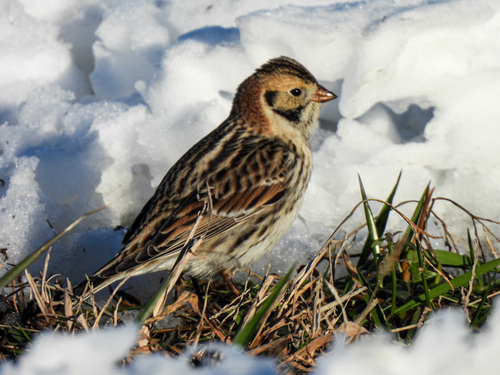
Lapland Bunting (Calcarius lapponicus) Lapland Bunting
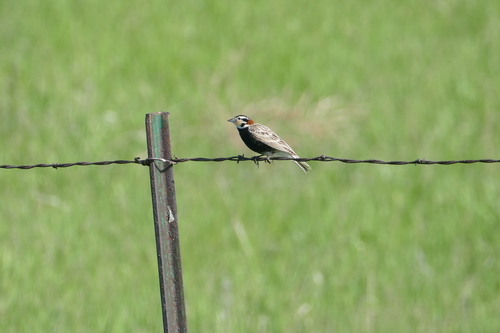
Chestnut-collared Longspur (Calcarius ornatus) Chestnut-collared Longspur

Media

Loading…

In short

Lapland Bunting and Chestnut-collared Longspur can be distinguished by habitat and plumage. Lapland Bunting prefers tundra habitats, while Chestnut-collared Longspur is found in prairie grasslands. In breeding plumage, the male Chestnut-collared Longspur has a distinctive chestnut collar and black belly, unlike the more muted tones of the Lapland Bunting.

Identification tips

Size

Both species are similar in size, typical of longspurs, with no significant differences noted in field observations.

Plumage

Male Chestnut-collared Longspur is notable for its chestnut collar, black belly, and yellow cheek, while the Lapland Bunting has a more subdued appearance with no such striking features. Female Chestnut-collared Longspur is buff-colored, blending into prairie habitats, whereas female Lapland Bunting is similarly cryptic but lacks the chestnut tones.

Behaviour

Chestnut-collared Longspur performs Aerial Song Displays during breeding, which is not typical of Lapland Bunting. Both species exhibit territorial behavior during the breeding season.

Habitat

Lapland Bunting is found in tundra habitats during breeding, while Chestnut-collared Longspur inhabits prairie grasslands, often in areas with short, sparse vegetation maintained by grazing.

Voice

Chestnut-collared Longspur has a melodic song often delivered during aerial displays. Lapland Bunting's song is less documented but not described as particularly melodic or associated with flight displays.

Submit a better description

Use the same sections as the comparison. Your text is published immediately.

Lapland Bunting and Chestnut-collared Longspur can be distinguished by habitat and plumage. Lapland Bunting prefers tundra habitats, while Chestnut-collared Longspur is found in prairie grasslands. In breeding plumage, the male Chestnut-collared Longspur has a distinctive chestnut collar and black belly, unlike the more muted tones of the Lapland Bunting.

  • Look for chestnut collar and black belly on male Chestnut-collared Longspur.
  • Observe habitat: tundra for Lapland Bunting, grasslands for Chestnut-collared Longspur.
  • Note behavior: aerial song displays are characteristic of Chestnut-collared Longspur.
  • Female Chestnut-collared Longspur is buff and blends into prairies, while female Lapland Bunting is similarly cryptic but lacks chestnut tones.

Both species are similar in size, typical of longspurs, with no significant differences noted in field observations.

Male Chestnut-collared Longspur is notable for its chestnut collar, black belly, and yellow cheek, while the Lapland Bunting has a more subdued appearance with no such striking features. Female Chestnut-collared Longspur is buff-colored, blending into prairie habitats, whereas female Lapland Bunting is similarly cryptic but lacks the chestnut tones.

Chestnut-collared Longspur performs Aerial Song Displays during breeding, which is not typical of Lapland Bunting. Both species exhibit territorial behavior during the breeding season.

Lapland Bunting is found in tundra habitats during breeding, while Chestnut-collared Longspur inhabits prairie grasslands, often in areas with short, sparse vegetation maintained by grazing.

Chestnut-collared Longspur has a melodic song often delivered during aerial displays. Lapland Bunting's song is less documented but not described as particularly melodic or associated with flight displays.

Discard your changes?

You have unsaved edits. If you leave now, those changes will be lost.

Lapland Bunting · Chestnut-collared Longspur · My Tricky Birds