Birdr

Lapland Bunting vs Smith's Longspur

Calcarius lapponicus versus Calcarius pictus

Play a quiz with Lapland Bunting and Smith's Longspur
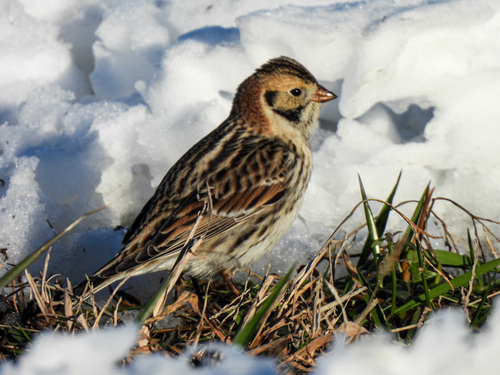
Lapland Bunting (Calcarius lapponicus) Lapland Bunting
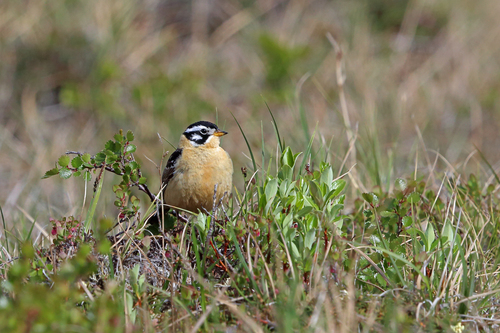
Smith's Longspur (Calcarius pictus) Smith's Longspur

Media

Loading…

In short

Lapland Bunting and Smith's Longspur are both small, ground-dwelling birds of the Calcariidae family. The most reliable field mark is the Lapland Bunting's distinctive black face and chestnut nape in breeding males, which contrasts with Smith's Longspur's more uniform and muted plumage. Both species can be found in open habitats, but their breeding ranges do not typically overlap.

Identification tips

Size

Both species are similar in size, typical of longspurs, with no significant size difference to aid in field identification.

Plumage

Breeding male Lapland Buntings have a striking black face and chestnut nape, whereas Smith's Longspur males have a more subtle plumage with a buffy face and chestnut on the wings. Non-breeding and female plumages are more similar but Lapland Buntings still show more contrast with their streaked backs.

Behaviour

Lapland Buntings are often seen in flocks during migration and winter, while Smith's Longspurs are noted for their promiscuous mating system, where multiple males may assist in feeding the young.

Habitat

Lapland Buntings breed in the high Arctic tundra, while Smith's Longspurs prefer subarctic and boreal grasslands. Both species migrate to open fields and grasslands in winter.

Voice

Lapland Buntings have a distinctive, musical song that is often heard during the breeding season. Smith's Longspur's song is less well-documented but is generally softer and less varied.

Submit a better description

Use the same sections as the comparison. Your text is published immediately.

Lapland Bunting and Smith's Longspur are both small, ground-dwelling birds of the Calcariidae family. The most reliable field mark is the Lapland Bunting's distinctive black face and chestnut nape in breeding males, which contrasts with Smith's Longspur's more uniform and muted plumage. Both species can be found in open habitats, but their breeding ranges do not typically overlap.

  • Breeding males: Look for the black face and chestnut nape in Lapland Bunting.
  • Non-breeding/females: Check for more contrast and streaking in Lapland Bunting.
  • Habitat: Consider the breeding range; Lapland Bunting in Arctic tundra, Smith's Longspur in subarctic grasslands.
  • Behavior: Note flocking behavior in Lapland Bunting and the unusual mating system in Smith's Longspur.

Both species are similar in size, typical of longspurs, with no significant size difference to aid in field identification.

Breeding male Lapland Buntings have a striking black face and chestnut nape, whereas Smith's Longspur males have a more subtle plumage with a buffy face and chestnut on the wings. Non-breeding and female plumages are more similar but Lapland Buntings still show more contrast with their streaked backs.

Lapland Buntings are often seen in flocks during migration and winter, while Smith's Longspurs are noted for their promiscuous mating system, where multiple males may assist in feeding the young.

Lapland Buntings breed in the high Arctic tundra, while Smith's Longspurs prefer subarctic and boreal grasslands. Both species migrate to open fields and grasslands in winter.

Lapland Buntings have a distinctive, musical song that is often heard during the breeding season. Smith's Longspur's song is less well-documented but is generally softer and less varied.

Discard your changes?

You have unsaved edits. If you leave now, those changes will be lost.

Lapland Bunting · Smith's Longspur · My Tricky Birds