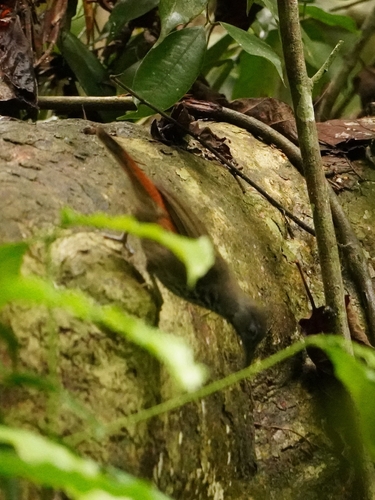
Large Scimitar-Babbler vs Chestnut-rumped Babbler
Erythrogenys hypoleucos versus Stachyris maculata
Play a quiz with Large Scimitar-Babbler and Chestnut-rumped Babbler
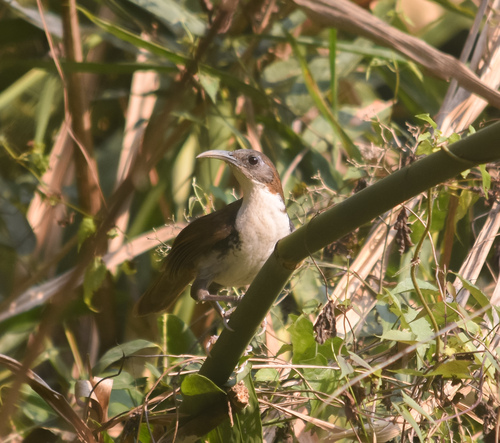
Large Scimitar-Babbler
Chestnut-rumped Babbler
In short
The Large Scimitar-Babbler and Chestnut-rumped Babbler can be distinguished primarily by their bill shape and plumage. The Large Scimitar-Babbler has a long, curved bill and a more uniform plumage, while the Chestnut-rumped Babbler features a distinct chestnut rump and a shorter, less curved bill.
Identification tips
- Look for the long, curved bill of the Large Scimitar-Babbler. 2. Check for the chestnut rump on the Chestnut-rumped Babbler. 3. Observe the plumage pattern: more uniform in the Large Scimitar-Babbler, more streaked in the Chestnut-rumped Babbler. 4. Note the habitat: dense undergrowth for Large Scimitar-Babbler, lowland forests for Chestnut-rumped Babbler. 5. Listen for vocal differences if possible, though specifics are uncertain.
Size
The Large Scimitar-Babbler is generally larger than the Chestnut-rumped Babbler.
Plumage
The Large Scimitar-Babbler has a more uniform brown plumage with a white throat and breast, lacking the distinct chestnut rump of the Chestnut-rumped Babbler. The Chestnut-rumped Babbler also has a more patterned appearance with streaks on the chest.
Behaviour
Both species are often found in flocks and can be secretive, but the Large Scimitar-Babbler tends to forage more on the ground compared to the Chestnut-rumped Babbler.
Habitat
Both species inhabit forested areas, but the Large Scimitar-Babbler is more often found in dense undergrowth and bamboo thickets, while the Chestnut-rumped Babbler prefers lowland forests.
Voice
The vocalizations of these species are not well-documented in the sources, but they likely differ in tone and pattern as is common among babblers.
Large Scimitar-Babbler · Chestnut-rumped Babbler · My Tricky Birds