Birdr

Laughing Dove vs Mourning Dove

Spilopelia senegalensis versus Zenaida macroura

Play a quiz with Laughing Dove and Mourning Dove
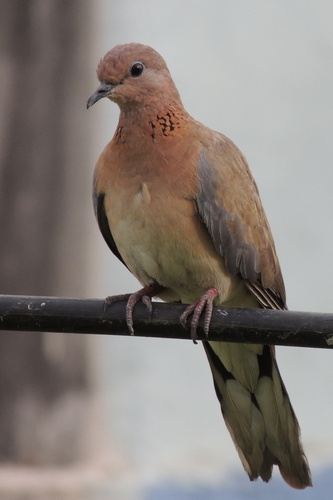
Laughing Dove (Spilopelia senegalensis) Laughing Dove
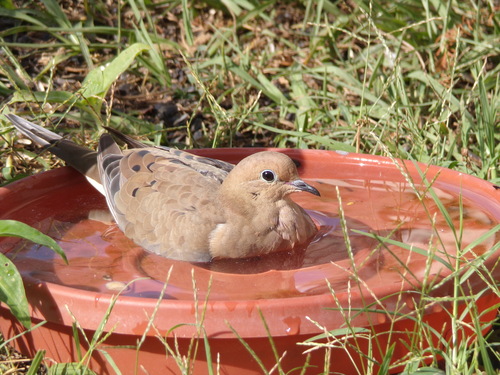
Mourning Dove (Zenaida macroura) Mourning Dove

Media

Loading…

In short

The Laughing Dove and Mourning Dove are both small, slender doves, but they differ in plumage and vocalizations. The Laughing Dove is more uniformly colored with a distinctive scaly pattern on its neck, while the Mourning Dove has a more muted appearance with long, pointed tail feathers. Their calls are also distinct, with the Laughing Dove having a rolling 'coo' and the Mourning Dove emitting a mournful, drawn-out cooing sound.

Identification tips

  1. Look for the scaly neck pattern on the Laughing Dove. 2. Note the longer, pointed tail with white edges on the Mourning Dove. 3. Listen for the distinct vocalizations: the Laughing Dove's rolling 'coo' versus the Mourning Dove's mournful 'coo'. 4. Consider the habitat: Laughing Doves prefer arid regions, while Mourning Doves are more widespread in open areas.

Size

Both species are similar in size, but the Mourning Dove has a slightly longer tail, giving it a more elongated appearance.

Plumage

The Laughing Dove has a pinkish-brown body with a distinctive scaly pattern on the neck, while the Mourning Dove is more uniformly gray-brown with black spots on the wings and a long, pointed tail with white edges.

Behaviour

Both species are often seen foraging on the ground, but the Mourning Dove is more likely to be found in open habitats and is a frequent visitor to bird feeders.

Habitat

The Laughing Dove is typically found in arid and semi-arid regions, often near human habitation, while the Mourning Dove is a habitat generalist, found in a wide range of open and semi-open areas across North America.

Voice

The Laughing Dove's call is a soft, rolling 'coo', while the Mourning Dove's call is a mournful, drawn-out 'coo' that is distinctive and recognizable.

Submit a better description

Use the same sections as the comparison. Your text is published immediately.

The Laughing Dove and Mourning Dove are both small, slender doves, but they differ in plumage and vocalizations. The Laughing Dove is more uniformly colored with a distinctive scaly pattern on its neck, while the Mourning Dove has a more muted appearance with long, pointed tail feathers. Their calls are also distinct, with the Laughing Dove having a rolling 'coo' and the Mourning Dove emitting a mournful, drawn-out cooing sound.

  1. Look for the scaly neck pattern on the Laughing Dove. 2. Note the longer, pointed tail with white edges on the Mourning Dove. 3. Listen for the distinct vocalizations: the Laughing Dove's rolling 'coo' versus the Mourning Dove's mournful 'coo'. 4. Consider the habitat: Laughing Doves prefer arid regions, while Mourning Doves are more widespread in open areas.

Both species are similar in size, but the Mourning Dove has a slightly longer tail, giving it a more elongated appearance.

The Laughing Dove has a pinkish-brown body with a distinctive scaly pattern on the neck, while the Mourning Dove is more uniformly gray-brown with black spots on the wings and a long, pointed tail with white edges.

Both species are often seen foraging on the ground, but the Mourning Dove is more likely to be found in open habitats and is a frequent visitor to bird feeders.

The Laughing Dove is typically found in arid and semi-arid regions, often near human habitation, while the Mourning Dove is a habitat generalist, found in a wide range of open and semi-open areas across North America.

The Laughing Dove's call is a soft, rolling 'coo', while the Mourning Dove's call is a mournful, drawn-out 'coo' that is distinctive and recognizable.

Discard your changes?

You have unsaved edits. If you leave now, those changes will be lost.

Laughing Dove · Mourning Dove · My Tricky Birds