Birdr

Laughing Gull vs Franklin's Gull

Leucophaeus atricilla versus Leucophaeus pipixcan

Play a quiz with Laughing Gull and Franklin's Gull
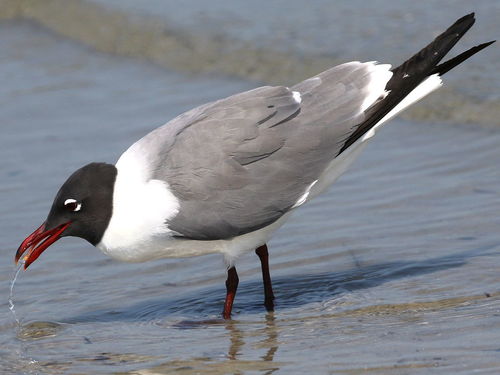
Laughing Gull (Leucophaeus atricilla) Laughing Gull
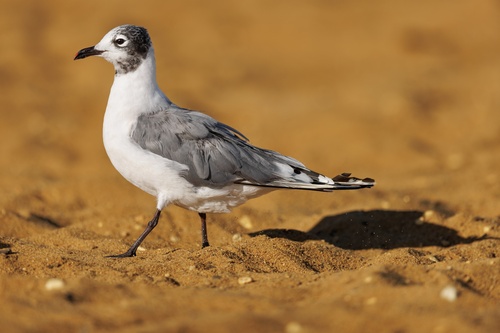
Franklin's Gull (Leucophaeus pipixcan) Franklin's Gull

Media

Loading…

In short

Laughing Gull and Franklin's Gull are both small, black-hooded gulls, but they can be distinguished by their habitat preferences and subtle plumage differences. Laughing Gulls are coastal, while Franklin's Gulls breed in inland marshes. In flight, Franklin's Gull shows a more pronounced white wing edge.

Identification tips

Size

Both species are similar in size, with no significant difference noticeable in the field.

Plumage

Laughing Gull has a dark gray mantle and black head with narrow white eye-crescents. Franklin's Gull also has a black head but is noted for its pinkish hue on the breast and a more pronounced white trailing edge on the wings during flight.

Behaviour

Laughing Gulls are often seen around human activity, scavenging at beaches and docks. Franklin's Gulls are more likely to be found in large flocks in prairie marshes, often following agricultural machinery.

Habitat

Laughing Gulls are typically found along the Atlantic and Gulf coasts, while Franklin's Gulls breed in interior North American marshes and migrate to the west coast of South America.

Voice

Laughing Gulls are known for their 'laughing' calls, which are a familiar sound along the coast. Franklin's Gulls have a less distinctive call, not as commonly noted in field guides.

Submit a better description

Use the same sections as the comparison. Your text is published immediately.

Laughing Gull and Franklin's Gull are both small, black-hooded gulls, but they can be distinguished by their habitat preferences and subtle plumage differences. Laughing Gulls are coastal, while Franklin's Gulls breed in inland marshes. In flight, Franklin's Gull shows a more pronounced white wing edge.

  • Habitat: Laughing Gull is coastal; Franklin's Gull is found in inland marshes.
  • Wing Pattern: Franklin's Gull shows a more pronounced white trailing edge on the wings.
  • Breast Hue: Franklin's Gull may show a pinkish hue on the breast.
  • Behavior: Look for Laughing Gulls around human activity and Franklin's Gulls in large inland flocks.

Both species are similar in size, with no significant difference noticeable in the field.

Laughing Gull has a dark gray mantle and black head with narrow white eye-crescents. Franklin's Gull also has a black head but is noted for its pinkish hue on the breast and a more pronounced white trailing edge on the wings during flight.

Laughing Gulls are often seen around human activity, scavenging at beaches and docks. Franklin's Gulls are more likely to be found in large flocks in prairie marshes, often following agricultural machinery.

Laughing Gulls are typically found along the Atlantic and Gulf coasts, while Franklin's Gulls breed in interior North American marshes and migrate to the west coast of South America.

Laughing Gulls are known for their 'laughing' calls, which are a familiar sound along the coast. Franklin's Gulls have a less distinctive call, not as commonly noted in field guides.

Discard your changes?

You have unsaved edits. If you leave now, those changes will be lost.

Laughing Gull · Franklin's Gull · My Tricky Birds