
Laughing Gull vs Pallas's Gull
Leucophaeus atricilla versus Ichthyaetus ichthyaetus
Play a quiz with Laughing Gull and Pallas's Gull
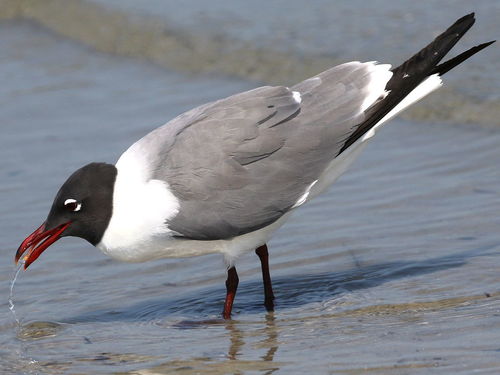
Laughing Gull
Pallas's Gull
In short
The Laughing Gull and Pallas's Gull can be distinguished by their size and head markings. Laughing Gulls are smaller with a distinctive black hood and white eye crescents, while Pallas's Gulls are larger with a black cap and a white forehead. Both species have dark mantles but differ in their vocalizations and preferred habitats.
Identification tips
- Size: Laughing Gull is noticeably smaller than Pallas's Gull.
- Head markings: Look for the black hood and white eye crescents on Laughing Gulls during breeding season; Pallas's Gulls have a black cap and white forehead.
- Vocalization: Listen for the Laughing Gull's characteristic laughing call.
- Habitat: Consider the location; Laughing Gulls are more coastal, while Pallas's Gulls are often inland or in Eurasian coastal areas.
Size
Laughing Gull is smaller, typically around 36–41 cm in length, whereas Pallas's Gull is larger, measuring about 55–65 cm.
Plumage
Laughing Gull has a black hood with narrow white eye crescents during the breeding season, and a dark gray mantle. Pallas's Gull has a black cap with a white forehead and a paler gray mantle. In non-breeding plumage, Laughing Gulls lose their black hood, while Pallas's Gulls maintain their cap.
Behaviour
Laughing Gulls are often seen in large colonies, engaging in courtship displays with head tosses. Pallas's Gulls are less social, often seen in pairs or small groups.
Habitat
Laughing Gulls prefer coastal areas, sandy beaches, and salt marshes, particularly along the Atlantic and Gulf coasts. Pallas's Gulls are found in inland lakes and coastal regions across Eurasia.
Voice
Laughing Gulls are known for their distinctive 'laughing' calls, while Pallas's Gulls have a deeper, more guttural call.