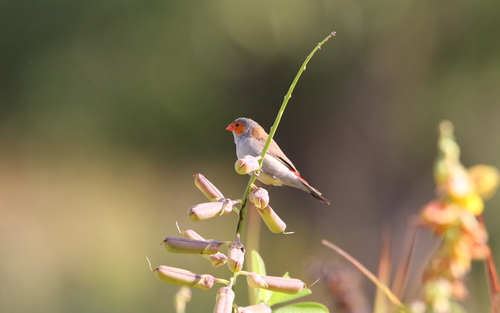
Lavender Waxbill vs Orange-cheeked Waxbill
Glaucestrilda caerulescens versus Estrilda melpoda
Play a quiz with Lavender Waxbill and Orange-cheeked Waxbill

Lavender Waxbill
Orange-cheeked Waxbill
In short
The Lavender Waxbill and Orange-cheeked Waxbill are both small, colorful finches from the Estrildidae family. The most reliable field mark is the presence of bright orange cheeks on the Orange-cheeked Waxbill, which are absent in the Lavender Waxbill. Both species have similar body shapes and sizes, but their plumage and cheek coloration are key differentiators.
Identification tips
- Look for the bright orange cheeks on the Orange-cheeked Waxbill; the Lavender Waxbill lacks this feature. 2. Note the red rump and tail of the Orange-cheeked Waxbill. 3. Observe the overall plumage color: lavender wash in Lavender Waxbill vs. grey and brown in Orange-cheeked Waxbill. 4. If possible, observe in good light to accurately assess cheek and rump coloration.
Size
Both species are small and similar in size, typical of waxbills, making size an unreliable distinguishing feature.
Plumage
The Lavender Waxbill has a predominantly grey body with a lavender wash, while the Orange-cheeked Waxbill features a more striking combination of grey and brown with distinct bright orange cheeks. The Orange-cheeked Waxbill also has a red rump and tail, which can help in identification.
Behaviour
Both species exhibit similar behaviors typical of waxbills, such as foraging in small flocks and being highly active. Behavior alone is not a reliable differentiator.
Habitat
Both species can be found in similar habitats such as grasslands and savannas, often near water sources. They are adaptable and can be seen in both wild and urban settings.
Voice
Vocalizations are not a primary distinguishing feature between these species, as both have typical waxbill calls that are high-pitched and twittering.