
Least Bittern vs Little Bittern
Botaurus exilis versus Botaurus minutus
Play a quiz with Least Bittern and Little Bittern
 Least Bittern
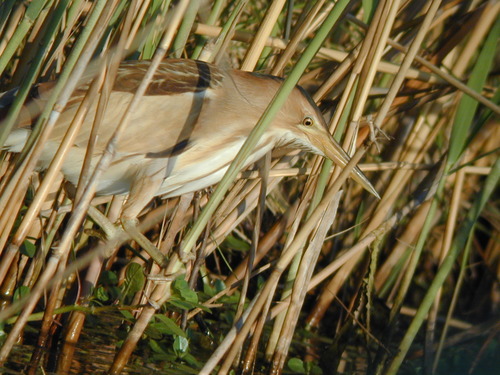 Little Bittern
In short
The most reliable field mark between Least Bittern and Little Bittern is size: Least Bittern is notably smaller and lighter, with a much shorter wingspan and lower body mass. In flight, both species show pale wing panels, but the color and prominence differ by age and sex. Adult males of both have dark upperparts, but Least Bittern males are glossier greenish-black, while Little Bittern males are black with a faint green sheen. Juveniles and females are browner and more streaked in both, but Little Bittern juveniles are especially rufous and heavily streaked above and below. Structure is also helpful: Least Bittern is more delicate and compact, with a slimmer build. Habitat overlap is possible in Eurasia (Little Bittern) and the Americas (Least Bittern), but not locally. Use size, wing panel color, and streaking to separate them, especially in flight or among reeds.
Identification tips
- Size is the first check: Least Bittern is much smaller and lighter than Little Bittern. If the bird appears very small, delicate, and compact among reeds, favor Least Bittern. If it looks more robust and long-winged, consider Little Bittern.
- Wing panel color in flight: Adult male Least Bittern shows a light brown wing panel; Little Bittern male shows a pinkish-buff oval panel contrasting with black wings. In females and juveniles, the panel is duller and less distinct in Little Bittern.
- Juvenile streaking: Juvenile Little Bitterns are heavily rufous and streaked above and below, including the wing coverts. Least Bittern juveniles are streaked below but not as rufous or heavily marked above.
- Adult male upperparts: Least Bittern males have glossy greenish-black crown and back; Little Bittern males are black with a faint green sheen. This is subtle but can be seen in good light.
- Shoulder lines: Both sexes of Least Bittern have white lines on their shoulders, which are lacking or less obvious in Little Bittern.
- Underparts: Least Bittern has white with light brown streaks on the underparts and throat; Little Bittern males are pale buff below, females and juveniles are streaked dark buff and brown.
- Bill and eye color: Least Bittern has a yellow bill and yellow eyes; Little Bittern has a long, sharp bill but eye color is not specified as diagnostic.
- Behavior when alarmed: Least Bittern often freezes with bill up and sways to mimic reeds; Little Bittern may freeze but is less likely to sway.
- Habitat context: In the Americas, only Least Bittern occurs; in Europe, Africa, and Asia, only Little Bittern. If you are outside the Americas, rule out Least Bittern.
- Flight jizz: Least Bittern appears more fluttery and weak in flight due to small size; Little Bittern is more direct and stronger on the wing.
- Sex differences: Males of both are darker above, but female and juvenile Little Bitterns are browner and more streaked than Least Bittern equivalents.
- Shoulder and covert pattern: Least Bittern's white shoulder lines and light brown wing coverts are useful in perched birds; Little Bittern's pale panel is more obvious in flight, especially in males.
- Streaking on upperparts: Juvenile Little Bitterns are more heavily streaked on the upperparts than Least Bittern juveniles.
- Wingspan and body length: If you have a good view or a photo, compare wingspan and body length to nearby birds or reeds; Least Bittern is notably smaller.
- Seasonal timing: Both are migratory, but check local field guides for presence by month—Least Bittern in the Americas, Little Bittern in Eurasia/Africa.
Size
Least Bittern is substantially smaller and lighter than Little Bittern. Adult Least Bittern averages 80g in body mass, with a length of 28–36 cm and a wingspan of 41–46 cm. Little Bittern is nearly twice as heavy at 147g, with a length of 33–38 cm and a wingspan of 52–58 cm. In the field, Least Bittern appears much more delicate and compact, while Little Bittern is chunkier and longer-winged. This size difference is often obvious when seen side by side or with familiar marsh birds for scale.
Plumage
Juvenile and female plumages are the main pitfall. Both species show pale wing panels in flight, but the color and contrast differ: Least Bittern (all ages) has light brown covert feathers forming the panel, while Little Bittern males have a pinkish-buff oval panel (inner coverts) that contrasts strongly with otherwise black wings; female and juvenile Little Bitterns have a less obvious, duller panel. Juvenile Little Bitterns are much more rufous and heavily streaked above and below, including on the wing coverts, compared to Least Bittern juveniles, which are streaked below but not as rufous or heavily marked above. Adult males of both have dark upperparts, but Least Bittern males are glossy greenish-black and Little Bittern males are black with a faint green sheen. Females of both are browner, but Least Bittern females have glossy brown upperparts with white shoulder lines, while Little Bittern females have brownish-black upperparts with paler feather margins and more streaked underparts.
Behaviour
Least Bittern is extremely elusive, often straddling reeds and freezing with bill pointed up when alarmed, sometimes swaying to mimic vegetation. It is more likely to be seen climbing among reeds than wading in open water. Little Bittern is also secretive but may be seen more often in open at the edge of reeds. Both species are more often heard than seen, but Least Bittern is especially adept at compressing its body to squeeze through dense vegetation.
Habitat
Least Bittern is found in large marshes with dense emergent vegetation (cattails, rushes) in the Americas. Little Bittern occupies similar wetland habitats in Europe, Africa, and Asia, breeding in reedbeds and marshes. There is no range overlap, so geographic context is usually decisive, but both can be found in dense reedbeds and marshes within their respective continents.